

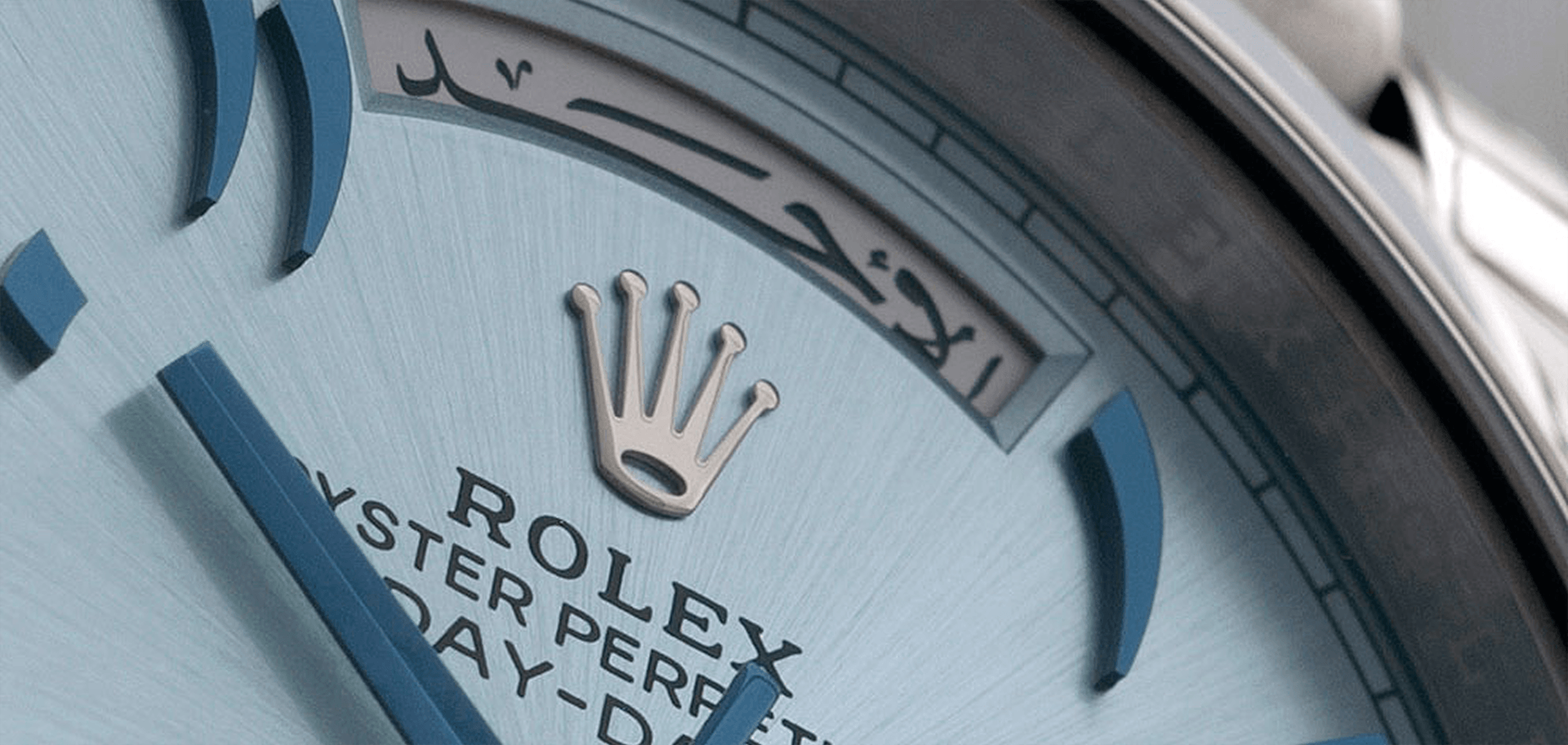
Certain Rolex watches made for, sold in, or formally presented within the Middle East carry a collector importance that goes beyond the core reference number. Their value can come from regional history, original dial markings, royal or military provenance, correct accessories, and a verifiable ownership story that connects the watch to a specific moment or institution in the Gulf. But a regional symbol alone is not enough. A UAE coat of arms, a Khanjar marking, or Eastern Arabic numerals add genuine significance only when the rest of the picture holds together: originality confirmed, documentation credible, production period consistent, and condition appropriate to the age and claimed history. Without that, a marking is just a marking.
What makes a Rolex a Middle East collector watch?
Rolex has produced watches for the Middle East that differ from their standard catalogue configurations. Some carry national coats of arms or emblems on the dial. Others feature Eastern Arabic numerals rather than Western ones. Some were commissioned for official presentation, gifted by governments or rulers to military officers, diplomats, or visiting dignitaries. Others were sold through regional retailers and carry retailer designations that place them specifically in the Gulf’s watch-buying history.
These watches are not rare simply because they exist. They are significant when the specific combination of reference, production period, dial configuration, documentation, and ownership story is intact and verifiable. Auction houses have documented examples of this over many years, and the most valuable regional Rolex pieces share a consistent quality: their provenance is a package, not a story added after the fact.
UAE watches: when a dial records a piece of history
Phillips has documented rare examples of Rolex made specifically for UAE institutions and officials. One recorded example is a Rolex produced for the UAE Armed Forces, carrying the UAE Armed Forces emblem directly on the dial. Another is a vintage GMT-Master II made for the UAE Ministry of Defence.
That Ministry of Defence example is particularly well documented. It carries the UAE Quraysh Hawk on the dial alongside a signature of His Highness Mohammed bin Rashid Al Maktoum. The watch was originally gifted to Captain José Hilario Trujillo in 1981, and its provenance materials trace the gift and the recipient. Phillips has also documented a Rolex steel chronograph with the UAE coat of arms and Mohammed bin Rashid Al Maktoum signature on the dial, carrying the wording Wazarah Ad Difa’A.
What these pieces share is not simply the marking. It is the full picture: the dial emblem matches the production period, the case shows no signs of later modification, the provenance documentation is credible, and the watch’s ownership story can be traced. That combination is what separates a genuinely collectible UAE piece from one where a marking has been added later.
Khanjars, Oman and the significance of presentation provenance
The Khanjar, the traditional curved dagger that forms Oman’s national emblem, appears on certain Rolex watches connected to Oman’s official gifting culture. These are among the most thoroughly documented of all Middle Eastern Rolex examples, and they illustrate clearly why presentation materials matter.
Christie’s Dubai has offered a 1974 Rolex Day-Date reference 1803 with a red Khanjar marking. What gave that piece its collector standing was not the marking alone but the supporting provenance: a Rolex guarantee confirming sale at Asprey and Co in 1974, a Sultan Qaboos gift card, a Rolex leather wallet, hang tag, and a presentation box with Khanjar logo. The gift chain was documented. The retailer history was verifiable.
Christie’s Dubai offered a second 1974 Day-Date 1803, this one with a blue dial and red Khanjar mark, along with an Asprey-engraved caseback. Sotheby’s has also documented a platinum Rolex Day-Date II reference 218206 with Arabic day and date, a royal Khanjar crest on the caseback, papers, and evidence that it was delivered to the Diwan of the Royal Court.
These pieces are not collector items because they have a Khanjar. They are collector items because the Khanjar is part of a complete and verifiable story.
Eastern Arabic numerals: why collectors look twice
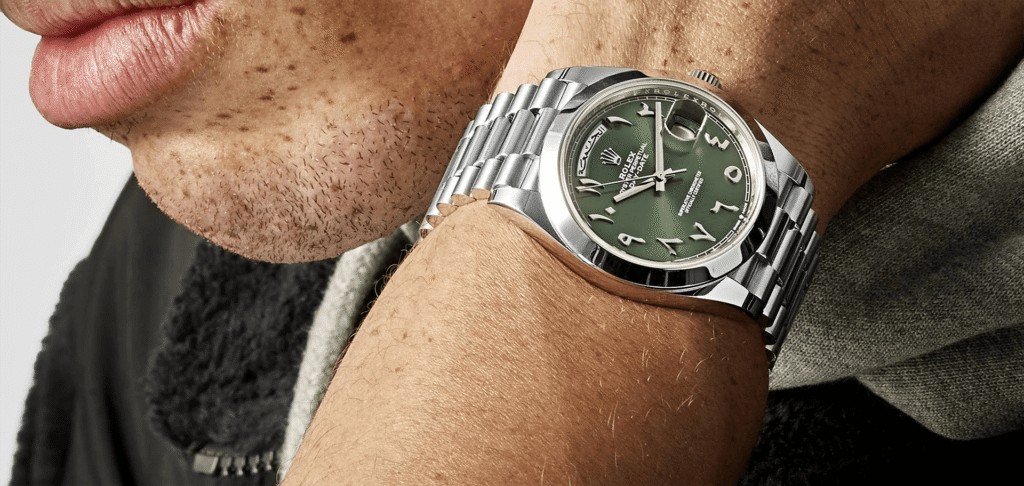
Eastern Arabic numeral Rolex watches, where the hour markers use the numeral forms common in Arabic script rather than Western numerals, have attracted sustained collector interest, particularly when combined with precious metals, original retailer provenance, and complete documentation.
Phillips documented a platinum Daytona reference 116506 with an ice-blue Eastern Arabic numeral dial. Supporting the piece was an original guarantee from Saddik and Mohamed Attar Co. in Saudi Arabia, a card holder, hangtags, and original packaging.
It is worth being direct about the limits of this category. Eastern Arabic numerals on a Rolex dial do not automatically create a valuable watch. The numeral configuration is one element. The reference itself needs collector standing. The dial must be confirmed factory original. The production context must align with the claimed retailer and period. Documentation must exist and be credible. A watch with Eastern Arabic numerals but no papers, unclear provenance, or a weak underlying reference is not straightforwardly valuable on the strength of the numeral style alone.
The provenance checklist
For any Middle Eastern or regional Rolex, serious buyers should work through these questions before committing:
Is the dial original? This is the central question. Regional markings on a refinished, replaced, or aftermarket dial change the entire collector proposition. A genuine factory original dial in original condition is the foundation of the piece’s value.
Does the reference fit the claimed configuration? A UAE Armed Forces emblem, Khanjar marking, or Eastern Arabic numeral configuration should correspond to a production period and reference that aligns with the known history of similar pieces.
Does the serial range make sense? The serial number should correspond to the production period claimed. A mismatch between the serial range and the claimed gift date or retailer history is a flag that requires investigation.
Are papers and accessories credible? A Rolex guarantee card, retailer receipt, gift card, or official correspondence should match the production period, reference, and claimed provenance. Papers from a different decade, a retailer not associated with the Gulf, or box materials inconsistent with the production year are worth questioning.
Does the retailer or presentation story align with the watch? The Asprey and Co. retailer history for Khanjar Day-Date examples is documented and traceable. Regional military gift provenance should similarly align with the reference, production period, and known institutional history.
Has the watch been altered or over-polished? Original case surfaces, unpolished lugs, and correct bracelet condition are important for any collector piece. An over-polished case or softened lugs signal work that affects both originality and value, regardless of the dial.
The red flags that matter
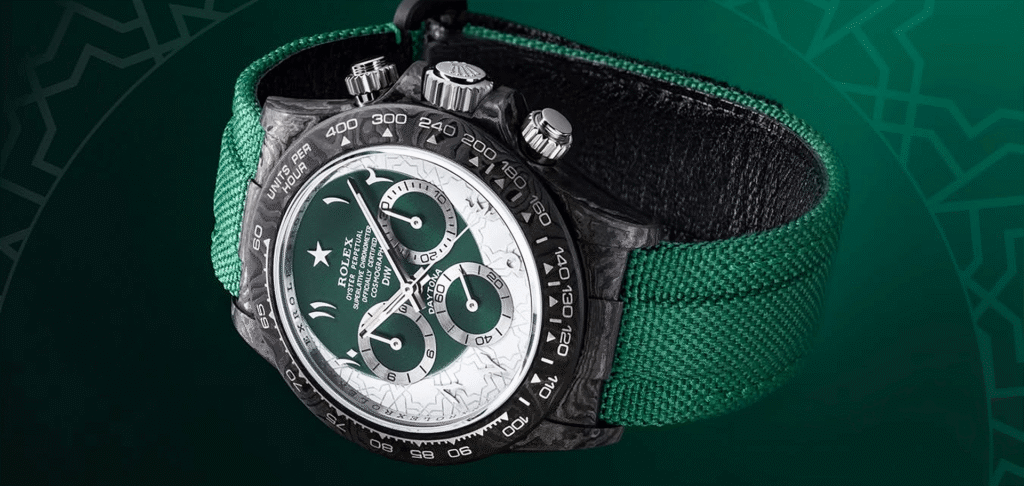
The regional Rolex category attracts a specific risk: aftermarket modification. A standard dial can have markings added by printing, painting, or other methods. This has happened often enough that any UAE emblem, Khanjar, military marking, or Eastern Arabic numeral configuration should be treated with caution until confirmed.
Specific red flags:
Aftermarket printing on the dial. The printing quality, font weight, and position of factory regional markings follow consistent specifications. Aftermarket additions often show subtle inconsistencies visible under magnification.
Unclear or mismatched documentation. A gift card that does not align with the claimed date, a Rolex guarantee from a different retailer than claimed, or papers in a condition inconsistent with the watch’s age.
Mismatched components. A Khanjar box with a watch whose serial number postdates the claimed gift year. A dial marking associated with a reference not produced in the period claimed.
Stories that cannot be traced. Genuine official gift pieces have a clear chain: an institution, a recipient, a date, a documented occasion. Provenance described only in general terms, without specific details that can be checked, warrants scepticism.
A regional marking should never be accepted based on photographs alone. Physical examination by a specialist, alongside full documentation review, is the minimum standard for a serious purchase in this category.
Why local authentication matters in Dubai
Dubai is the natural hub for Middle Eastern Rolex assessment. The regional collector community, the auction activity, and the provenance context are all accessible here in a way they are not in Geneva or New York. A specialist in Dubai can cross-reference a UAE Armed Forces dial against documented examples, assess whether the case condition is consistent with the claimed age, and review whether the paperwork aligns with known Rolex production and Gulf retail history.
WatchX’s authentication service covers reference and serial number details, movement calibre, case and dial inspection, visible components, and documentation review. For regional pieces, the documentation and provenance review is especially important. The authentication report documents condition and originality findings and provides written confirmation of what can and cannot be verified.
WatchX valuations for regional pieces draw on Dubai market data, international auction results, and the specific combination of reference, condition, and documentation present in the watch being assessed. A regional marking adds value only when the supporting picture is intact.
Final takeaway
A rare regional Rolex becomes meaningful when its entire story holds together. The dial, the reference, the serial, the production period, the documentation, the condition, and the ownership chain should all align. When they do, these watches carry a kind of significance that no standard production Rolex can replicate. When they do not, the regional marking is the least reliable element of the piece.
The Rolex collection at WatchX includes pre-owned references across the GCC market, and the team can advise on authentication and valuation for regional pieces.
Frequently asked questions
What is a UAE dial Rolex?
A UAE dial Rolex is a Rolex watch where the dial carries a marking specifically associated with the United Arab Emirates, such as the UAE coat of arms, a UAE Armed Forces emblem, or an official institutional marking. These were typically produced for official presentation, gifted to military officers or officials, or commissioned by UAE government institutions. Their collector value depends on confirmed dial originality, production period consistency, and verifiable documentation.
What is a Rolex Khanjar watch?
A Khanjar is the traditional curved dagger that forms Oman’s national emblem. A Rolex Khanjar watch carries this emblem on the dial, caseback, or as part of the presentation accessories. These watches were typically connected to Oman’s official gifting culture and are most valuable when the Khanjar marking is factory original and supported by a complete provenance package including retailer history, gift documentation, and period-correct accessories.
Are Arabic dial Rolex watches rare?
Eastern Arabic numeral Rolex watches are a collector category, but rarity depends on the specific reference, production period, condition, and documentation. A platinum Daytona with Eastern Arabic numerals and original Saudi retailer paperwork is a rare and specific piece. A Datejust with Eastern Arabic numerals in standard steel without documentation is a different proposition. The numeral style does not by itself make a watch rare.
Why do Middle East Rolex watches sell for more?
When they do command a premium, it is because of the combination of regional significance, confirmed factory original configuration, complete provenance documentation, and a narrow supply of genuine authenticated examples. The premium is justified when the entire provenance package is intact and verifiable. A regional marking without supporting documentation should not command the same premium.
How can I tell if a regional Rolex dial is original?
Physical examination by a qualified specialist is the only reliable method. Factory regional markings follow consistent specifications in printing quality, font, and positioning. Aftermarket additions often show inconsistencies visible under magnification. Photography is not sufficient for this assessment.
Does a presentation box prove a watch is genuine?
No. A presentation box with a Khanjar logo or UAE emblem supports the provenance story but does not confirm it independently. The box must be consistent with the production period and reference, the watch must align with the box, and all other documentation must support the same narrative. A box from a different period or inconsistent with the claimed retailer is a red flag, not reassurance.
Should I buy a UAE Armed Forces Rolex?
If the dial originality, production period, documentation, and condition all align and can be confirmed by independent authentication, a UAE Armed Forces Rolex can be a genuinely significant collector piece. If any of those elements is unclear or unverifiable, the premium is not justified. Independent authentication before purchase is strongly advisable.
Can WatchX authenticate a rare regional Rolex in Dubai?
Yes. WatchX’s authentication service covers reference and serial details, movement assessment, case, dial, bracelet, and visible component inspection, and provenance documentation review. For regional pieces, the documentation review is particularly important. Visit WatchX at JLT Cluster C, or contact the team to arrange an assessment before or after purchase.
WatchX is a certified pre-owned luxury watch dealer based in JLT, Dubai. WatchX is not an authorised retailer for any brand referenced in this article. This article does not constitute investment advice. Watch values depend on condition, documentation, market demand, and individual reference characteristics.