

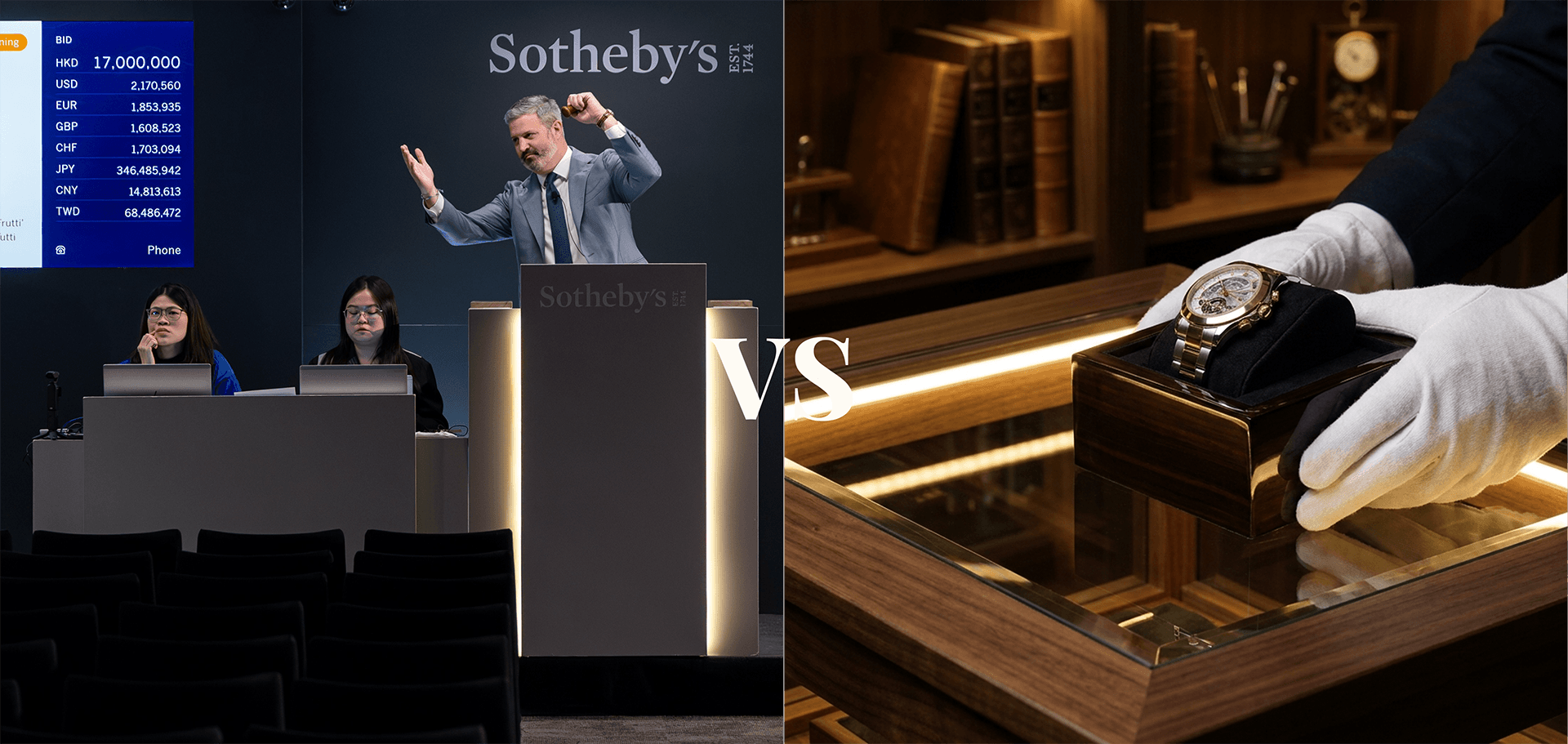
For most buyers in Dubai, a trusted local pre-owned dealer is the faster, clearer, and more practical route. You see the watch in person, you know the total price in AED before you commit, and you can discuss condition, papers, and service history face to face. But auctions are not a worse option across the board. For rare historical references, watches with unusual provenance, or pieces that simply do not appear through normal dealer inventory, an auction can be the only realistic path. The right choice depends entirely on the specific watch you want, not on a general preference for one channel over the other.
Why this question matters during auction season
October is part of the global autumn watch auction calendar. Sotheby’s Fine Watches begins 27 October 2026, and Sotheby’s Important Watches Hong Kong is scheduled for 16 to 17 October 2026. As these sales approach, buyers in Dubai start comparing what they see in auction estimates against what they can buy locally, often without fully understanding how different those two numbers are.
The estimate on an auction listing is not the price. It is guidance. The price you actually pay can be considerably more, depending on a range of fees, taxes, and logistics that are not visible in the lot description.
The number on the screen is not the final auction price
This is the point that catches the most buyers off guard. A watch listed in an auction catalogue with an estimate of AED 100,000 is not a AED 100,000 watch, at least not once you have paid everything required to own it.
Here is how the cost builds:
The estimate is the auction house’s guidance range for where the hammer might fall. It does not guarantee the watch will sell within it, and it does not include any fees.
The hammer price is what the winning bidder commits to when the auctioneer closes the lot. This is the opening cost, not the total cost.
The buyer’s premium is an additional charge applied by the auction house on top of the hammer price. The percentage varies by auction house and by sale. For a major international house, it is typically meaningful. Sotheby’s states that the total purchase price includes the hammer price, buyer’s premium, overhead premium where applicable, and local taxes.
Taxes, shipping, insurance, and import duty may also apply depending on where the auction is held, where you are located, and how the watch is delivered. Christie’s Dubai online-sale terms make clear that buyer’s premium is charged on the hammer price, with shipping, loss and damage liability charges, and relevant duties or taxes potentially adding to the final cost.
A practical example: if a watch hammers at AED 100,000, the buyer’s premium alone could add AED 15,000 to AED 25,000 or more before shipping, insurance, and import duties enter the calculation. Whether that final total is still a better deal than the same watch at a Dubai dealer depends entirely on the reference, condition, and what each option actually includes.
The right comparison is always total delivered cost against total delivered cost, not estimate against retail.
What an auction condition report can and cannot tell you
Major auction houses produce condition reports for lots, and these are worth reading carefully. Sotheby’s describes a condition report as a written description prepared by specialists before the auction, with online images also considered part of that information.
A condition report is useful, but it is not a substitute for seeing the watch yourself or having a specialist examine it on your behalf. There are condition issues that affect value significantly but are not always fully described in a general written report:
Case and bracelet issues
- Over-polished cases where the brushed and polished surfaces have been smoothed out together
- Softened lugs that no longer hold their original sharpness
- Bracelet stretch that adds play and looseness
- Non-original bracelet components or replaced clasp parts
Dial and movement issues
- Refinished or chemically treated dials that no longer reflect original factory condition
- Replaced or incorrect hands or indices
- Non-original bezel or crystal
Documentation issues
- Missing warranty card or certificate
- Incorrect or unverifiable production period
- Papers that do not align with the watch’s serial number or configuration
- Box from a different period than the watch
Provenance issues
- Ownership history that cannot be traced or verified
- Regional markings that cannot be confirmed as factory original
For any watch above a certain price threshold, or for any technically unusual reference, requesting the condition report is essential. So is asking focused questions. A specialist in the reference you are buying can identify issues that a general auction description may not flag.
When buying at auction makes sense
Auctions remain the right route for specific situations:
Rare historical references that have not appeared in normal dealer inventory for years. A first-series Nautilus in original condition, a vintage Daytona in a specific dial configuration, a historically important reference from a specific production period: these are not usually sitting in a showroom.
Watches with unusual or documented provenance where the auction house has assembled the paperwork, photographs, and ownership history that supports the piece’s story. The right provenance can make a watch more meaningful to own and more valuable to sell later.
Middle East signed or commissioned watches with documented official history: UAE Armed Forces dial markings, royal gift cards, Ministry of Defence provenance, and similar. Auction houses like Phillips, Christie’s, and Sotheby’s have sold well-documented examples of these at auction where the full provenance package was assembled and verified.
Collectors who are comfortable with the process: bidding, fees, logistics, and the possibility that condition information is incomplete. Experienced auction buyers build this literacy over time.
When a Dubai dealer is the more practical choice

For most current or recent pre-owned Rolex, Patek Philippe, Audemars Piguet, Cartier, Vacheron Constantin, or Richard Mille references, a trusted local dealer offers a more straightforward path to ownership:
You know the full price before you commit. No buyer’s premium calculation. No shipping uncertainty. The price you discuss is the price you pay.
You can inspect the watch in person. This is not a small advantage. Seeing a dial in natural light, checking the bracelet play, examining the case surfaces and lug sharpness, and reviewing the original paperwork in your hands tells you things that high-resolution photographs cannot.
Condition is discussed directly. A trusted dealer will tell you what is original and what is not, whether the case has been polished, and what service history exists. You can ask questions and get answers before the purchase.
Trade options are available. If you have an existing watch, a local dealer can often factor it into the transaction in a way that an auction simply cannot.
Immediate availability. No waiting for a sale date, bidding window, payment period, and international shipping. If the watch is in the showroom and the price works, it can be on your wrist the same day.
Local after-sales support. If a question arises after purchase, you have a dealer in Dubai you can speak to directly.
The WatchX shop is updated regularly with certified pre-owned Rolex, Patek Philippe, Audemars Piguet, Richard Mille, Vacheron Constantin, and Cartier references. For specific pieces not currently in stock, the Watch Concierge service handles sourcing.
The seven questions to ask before bidding or buying
Whether you are considering an auction or a dealer, these questions apply:
What is the final all-in cost?
For an auction: hammer price plus buyer’s premium plus taxes plus shipping plus insurance plus any import duty. For a dealer: the stated price including any applicable VAT.
What condition issues are disclosed?
Ask specifically about case polishing, dial originality, bracelet stretch, and crystal condition. Do not rely on a photograph to reveal surface finish changes.
Are all visible components original?
This covers the dial, hands, bezel insert, bracelet, clasp, and crown. Any replacement should be disclosed and priced accordingly.
What documentation comes with the watch?
Original papers, warranty card matching the serial range, service records, purchase invoice, and box. Each affects both value and ease of future sale.
Can the watch be inspected before buying?
At a dealer, always. At a major auction, in-person previews are usually offered before the sale. Use them.
What happens if there is an issue after purchase?
A dealer’s warranty and return policy should be clear before you commit. An auction sale is generally final.
How easily can this watch be traded or sold later?
A reference with broad secondary market depth is easier to move than one with a narrow buyer pool. Understand the liquidity of what you are buying.
Auction, dealer, or sourcing request: choose based on the watch
There is a third option that is often overlooked: a sourcing request through a specialist dealer. If you want a specific reference that is neither currently in stock locally nor clearly available at upcoming auctions, a sourcing service can search the market, identify candidates, assess them on your behalf, and bring a verified option to you in Dubai.
WatchX handles sourcing requests for references outside current inventory through its Watch Concierge service. This can be a practical middle route for buyers who want a rare watch but do not want to manage auction logistics and international condition assessment alone.
Final takeaway
The better buying route is the one that gives you the right watch at the right price with clear condition and credible documentation. That is sometimes an auction, particularly for rare or historically important pieces. It is more often a trusted local dealer for current pre-owned references where inspection, pricing certainty, and local support matter.
The estimate on a catalogue page is the beginning of the conversation, not the conclusion.
Frequently asked questions
Is it cheaper to buy a luxury watch at auction?
Not necessarily. The hammer price is the opening cost, not the final one. Buyer’s premium, taxes, shipping, insurance, and potential import duty all add to the total. A watch that hammers at AED 100,000 can cost AED 130,000 or more by the time it arrives. Compare the total delivered cost against the dealer price, not the estimate against the retail price.
What is a buyer’s premium at a watch auction?
A buyer’s premium is a fee charged by the auction house on top of the hammer price. It is the auction house’s primary revenue mechanism. The percentage varies by auction house and sometimes by the value of the lot. Major international houses typically charge between 15% and 26% of the hammer price, sometimes on a sliding scale. Always check the specific sale’s terms before bidding.
Can I inspect a watch before bidding at auction?
Major auction houses typically offer in-person previews before a sale, and serious bidders use them. If you cannot attend in person, requesting high-resolution images, a detailed condition report, and asking focused questions about condition is the minimum. For high-value lots, having a specialist examine the watch on your behalf at the preview is worth the cost.
Are auction watches guaranteed to be authentic?
Auction houses do their own due diligence, but they are not infallible and their condition reports are not guarantees. If a significant issue is discovered after purchase, the remedy process can be complex and slow. Independent authentication before bidding is a sensible step for any high-value or technically unusual lot.
Should I buy a Rolex at auction or from a dealer in Dubai?
For a current pre-owned Rolex in good condition, a trusted Dubai dealer is usually the more practical route. You can inspect the watch, confirm condition and documentation, agree a clear AED price, and walk out the same day. Auctions make more sense for vintage Rolex references, unusual dial configurations, or historically documented pieces that do not appear in normal dealer stock.
Do auction prices include taxes and shipping?
No. Sotheby’s states that estimates do not include buyer’s premium, overhead premium, taxes, or potentially applicable resale royalties. Christie’s Dubai online sale terms note that shipping, loss and damage liability charges, and relevant duties or taxes may be added to the final cost. Always read the specific sale’s terms before bidding.
Can WatchX source a watch from outside Dubai?
Yes. The WatchX Watch Concierge service handles sourcing requests for specific references not currently in stock. This can include watches that would otherwise need to be purchased at an international auction, with WatchX managing the assessment, sourcing, and delivery of the piece to Dubai for the buyer’s review.
WatchX is a certified pre-owned luxury watch dealer based in JLT, Dubai. WatchX is not an authorized retailer for any brand referenced in this article.