

The most interesting thing happening to luxury watches in 2026 is not a new movement architecture or a technical milestone. It is the dial. Natural stone, golden obsidian, hand-hammered metal, lacquered green, aventurine, meteorite: material and texture have become the defining conversation at both Watches and Wonders 2026 and Geneva Watch Days. But the right collector question is not which dial is trending. It is whether the watch underneath the dial is worth owning regardless of what the dial is doing. This guide works through what the trend actually means, which dial choices are worth taking seriously, and the five questions every Dubai buyer should ask before paying a premium for an unusual face.
Why collectors are moving from hype to texture
There is a pattern that repeats in the luxury watch market about every five to seven years. A category becomes oversubscribed, prices peak, and a portion of the collector market begins looking for something more personal. After the steel sports watch cycle of 2018 to 2022, a portion of serious collectors has moved toward pieces that feel individual rather than immediately recognisable.
Stone dials and textured surfaces serve that interest directly. A malachite dial does not look like any other malachite dial. Natural stone varies by formation, colour distribution, and veining in ways that cannot be perfectly replicated. The same is true for meteorite, tiger’s eye, and aventurine. When a collector owns one, they own something genuinely singular, which is increasingly rare in a market where high-volume production has made many references feel interchangeable.
This move toward material individuality is also a response to maturity in the buyer base. The Dubai collector who bought their first Submariner in 2015 and their first Nautilus in 2019 is now on their fourth or fifth piece. They have graduated from “which brand” to “which specific configuration,” and a distinctive dial is a strong answer to that latter question.
What the 2026 watch fairs are showing
Geneva Watch Days, running 2 to 6 September 2026, has been the clearest single event for this trend. Among the most discussed pieces are a Gérald Genta golden obsidian minute repeater in 40mm yellow gold, three Gérald Charles Masterlink Atelier editions with hand-hammered Maillechort dials, and continued Bulgari movement in ultra-thin design with texture-forward finishes.
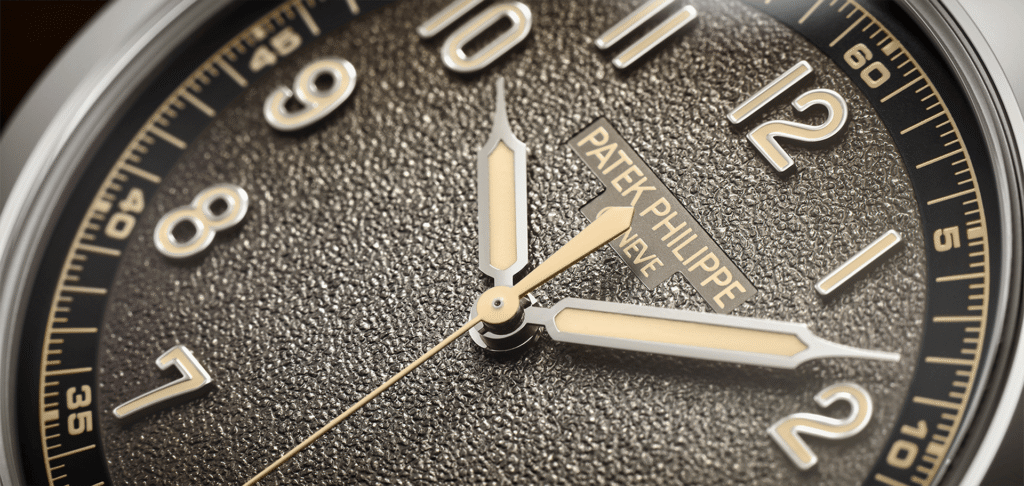
The golden obsidian minute repeater from Gérald Genta illustrates why independents often lead this kind of experimentation. Large brands need commercial volumes that constrain how unusual they can make a dial. A smaller maker can use a material like golden obsidian, which has optical depth that changes completely depending on the angle of light, because they are producing in limited numbers for buyers who are specifically seeking that kind of individuality.
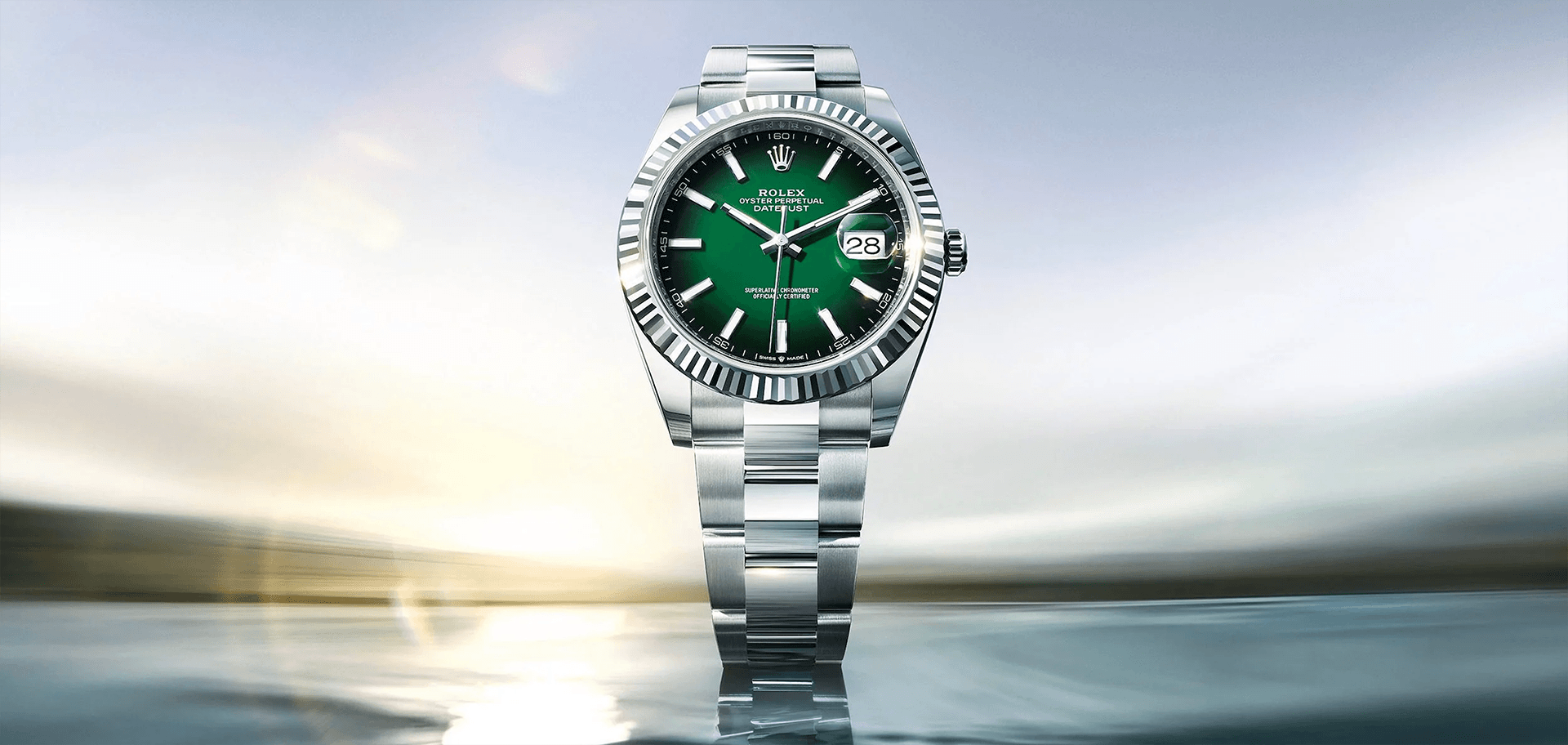
Watches and Wonders earlier in 2026 showed the major houses moving in the same direction, though with characteristic caution. Rolex’s green ombré lacquer dial on the Datejust 41 is the most significant example: it is technically complex, requires a lacquering process that has been refined since the ombré technique returned in 2019, and represents a meaningful statement from a brand that changes dial treatments rarely and deliberately.
Patek Philippe and Audemars Piguet have both extended their hard enamel and tapisserie dial programs, confirming that texture is not a passing novelty but a genuine direction the industry’s most established makers are committing to for the medium term.
Stone dials explained
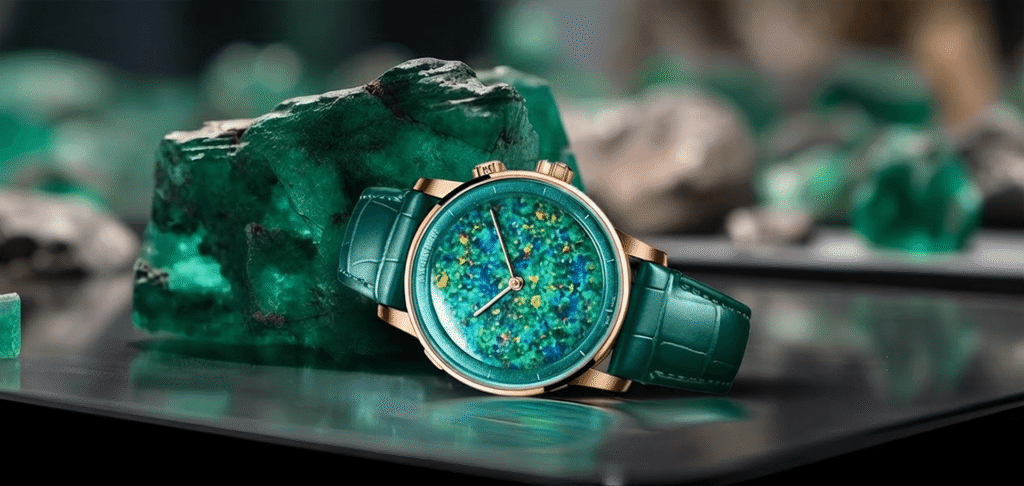
A stone dial is exactly what the name suggests: a watch dial cut, shaped, and finished from a natural mineral rather than a manufactured metal or lacquer base. The most common stones used in high watchmaking include malachite, lapis lazuli, onyx, aventurine, tiger’s eye, meteorite, turquoise, and hardstone composites. More unusual examples include golden obsidian, sodalite, and sunstone.
What makes stone dials different from other unusual dials is inherent variation. No two pieces of malachite have the same green swirl pattern. No two slices of meteorite show the same Widmanstätten crystalline structure. This means that when a watchmaker produces a stone dial edition of even five hundred pieces, each piece is individually distinct in a way that painted, lacquered, or printed dials are not.
There are practical considerations buyers should understand. Stone dials are more fragile than metal dials. A sharp impact that a metal dial absorbs can crack a stone dial. This does not make stone dial watches unwearable, but it is a reason to think about how and where you wear the piece. Stone dials also cannot be perfectly matched if damaged: a replacement dial cannot be cut from an identical piece of stone, which affects both the cost and possibility of dial restoration.
The fragility argument is often overstated by buyers who are hesitant about stone dials. A watch worn with normal care in professional and social settings faces very little risk. The consideration is more relevant for buyers thinking about an active daily wear piece that will encounter hard surfaces regularly.
Green is no longer a trend colour
Green entered the luxury watch conversation as a fashion moment around 2019 and 2020. In most categories, a colour that enters as a trend exits within two to three years. Green in luxury watches has not followed that pattern.
The reason is that green absorbed into the DNA of the references that wore it. Rolex green has specific associations with Oyster Perpetual models that created genuine collector demand. The Submariner “Starbucks” with its green bezel insert became one of the more liquid references in Rolex’s lineup. The GMT-Master II “Sprite” with its black and green cerachrom bezel has traded at premiums that confirm collectors are not treating it as a novelty.
Rolex’s 2026 Datejust 41 with a green ombré lacquer dial extends that logic. An ombré dial, where the colour graduates from deep at the centre to lighter at the edge or vice versa, is technically more demanding than a flat colour dial because the lacquering process requires precise control across the full surface. Rolex does not introduce this kind of technical variation unless they intend it to define the reference, which is a reasonable signal for buyers evaluating long-term dial desirability.
The collector verdict on green as a sustained colour is now reasonably clear: it has moved from trend to established. That does not mean every green dial watch is a strong purchase. It means the green dial question has graduated from “is this a passing colour” to the more relevant “is this specific reference, in this specific condition, a strong buy.”
The five questions to ask before paying a premium for a distinctive dial
These questions apply equally to a stone dial, an ombré lacquer, a meteorite face, or any dial treatment that carries a price premium over the standard reference.
1. Is the reference desirable even without this dial?
A distinctive dial can add genuine value to a strong reference. It cannot rescue a weak one. If the base watch, stripped of its unusual face, would not be a compelling purchase in its standard configuration, the dial is covering for underlying weakness rather than adding to underlying strength. Start with the reference. Evaluate the dial second.
2. Is the dial factory original?
Aftermarket dial modifications exist across the watch market and are especially prevalent in references where an unusual dial creates a significant price premium. An aftermarket modification can involve replacing a standard dial with a stone or lacquered surface, or applying treatments to an original dial that were not part of the manufacturer’s specification. The practical test is authentication: any unusual dial should be verifiable against the watch’s serial number, papers, and manufacturing period. WatchX inspects dial originality as part of its standard pre-purchase process, and the authentication service is available for buyers who want an independent assessment.
3. Is the dial production limited or merely new?
A stone dial on a new reference from a major house is not automatically scarce. Some stone dial editions run to hundreds of pieces. Others are genuinely limited to double-digit numbers. The distinction matters because scarcity is one of the drivers of secondary market premium. A stone dial edition of five thousand pieces will be traded very differently from a stone dial edition of fifty. Find out the production numbers before attributing rarity value to any specific dial.
4. Does the watch come with correct papers, service history, and condition?
This applies to every pre-owned watch, but it applies with extra weight to unusual dial pieces because the dial premium is meaningful and the provenance of that premium needs to be verifiable. A stone dial Rolex or Patek without papers is not only harder to sell: it is harder to authenticate as a genuine factory configuration, which is the fundamental question for any buyer paying above the standard reference price.
5. Can you live with this dial after the launch excitement fades?
This is the question that separates collectors from buyers who are following coverage. A stone dial that reads clearly at a normal arm distance, does not require explanation, and functions as a daily or regular-wear piece is a different long-term proposition from a stone dial that works as a photography subject but reads as confusing in person. Look at the watch in a normal indoor light setting, not only in the launch imagery. The launch photographs are shot to maximise the stone’s drama. Your wrist is not a studio.
Which dial types are likely to age best
This question cannot be answered with certainty, and any guide that offers guarantees about future collector values should be read with scepticism. What can be offered is a framework based on observable patterns in the pre-owned market.
Classic hardstones on established precious metal references have shown consistent long-term collector interest. A malachite dial on a yellow gold Patek or an onyx dial on a white gold Rolex can be found in historical auction results that reflect sustained demand across multiple decades. The combination of material rarity, precious metal case, and strong underlying reference creates multiple layers of desirability that tend to hold.
Dial colours tied to a historically significant reference accumulate collector interest over time. The Paul Newman Daytona dial was not considered especially desirable in the decades after it was produced. Collector attention built slowly, then dramatically. This does not mean every unusual historical dial will follow the same path, but it demonstrates that time and collector focus can build value in references that were initially unremarkable.
Understated textures on recognisable models tend to age better than loud novelty treatments on the same models. A brushed sunray dial, a hand-guilloche surface, or a deep lacquer finish with restrained colour on a well-known reference accumulates desirability because it adds craft without departing from the character of the watch. Loud novelty treatments can create initial hype and then become period pieces in a way that limits their long-term appeal.
Limited editions with transparent production numbers and genuine technical or material distinction age better than marketing-led editions where the limitation is stated but not meaningfully connected to the dial’s qualities.
Which dial choices require more caution
Trend colours without a strong underlying reference are the clearest caution zone. A colour that entered the market because a single brand made it popular, applied to a reference that has no particular collector standing on its own, is not a reliable purchase on investment grounds. Enjoy it for aesthetic reasons if it appeals, but price it accordingly.
Aftermarket modified dials are a risk that is disproportionately common in the stone dial and unusual dial category because the modification can be visually compelling and the premium significant. If you cannot verify the provenance of the dial treatment through papers, serial number correlation, and inspection, the dial should be priced as a standard reference until it can be verified.
Non-factory stones applied to otherwise standard references are a related risk. A watch that has had its original dial replaced with a stone surface has its value as a factory watch significantly affected. It can be an appealing object, but it is not the same commercial proposition as a factory stone dial configuration.
Watches where the price premium is not explained by scarcity, underlying reference quality, material rarity, or documented collector demand are the general caution. If the sole argument for a premium is “this dial is popular right now,” that is the least durable of all the reasons to pay more.
How this plays out in Dubai’s pre-owned market
Dubai buyers encounter more unusual pre-owned pieces than buyers in most other markets because the city’s concentration of wealth and its position as a trading hub means that globally scarce references circulate here more frequently than in smaller or more restricted markets. That is an advantage, but it comes with a corresponding responsibility to evaluate what you are seeing correctly.
The practical guidance for Dubai buyers considering an unusual dial piece in the pre-owned market:
Check dial originality specifically, not only general condition. A watch that looks correct in photographs can have a non-factory dial that only becomes apparent on close inspection or under watchmaker’s tools.
Compare the exact reference. A Rolex Datejust with a meteorite dial on a steel bracelet is a different secondary market proposition from the same dial configuration on a gold Oyster band. The bracelet, case material, and reference year all affect value in ways that are sometimes larger than the dial itself.
Request authentication, not only inspection. Inspection confirms condition. Authentication confirms that the dial configuration is genuine and corresponds to the watch’s original specification. The two are different services.
Consider the future resale audience before paying a significant premium. An unusual dial watch is not universally desirable. Some buyers specifically want unusual dials. Many buyers want the standard configuration of a reference. If you pay a significant dial premium, understand that your future buyer also needs to see the value in that specific configuration.
The full pre-owned collection at WatchX is inspected and priced with dial originality confirmed as part of the standard process. For buyers evaluating a specific unusual dial piece elsewhere, the WatchX authentication service provides independent assessment.
Frequently asked questions
Are stone dial watches trending in 2026?
Yes. Stone dials were among the most discussed features at both Watches and Wonders 2026 and Geneva Watch Days 2026. Materials including golden obsidian, malachite, aventurine, and meteorite appeared across multiple brands and price categories. The trend reflects a collector interest in individuality and craft rather than a single seasonal colour preference.
What is a stone dial watch?
A stone dial watch uses a slice of natural mineral, cut and shaped to fit the watch case, as the dial surface instead of a manufactured metal or lacquer base. Common stone types used in high watchmaking include malachite, lapis lazuli, onyx, meteorite, aventurine, and tiger’s eye. Because natural stone varies inherently, no two stone dial watches are identical even within the same reference edition.
Do stone dial watches hold their value?
Value retention depends on the underlying reference, the production numbers of the stone dial edition, dial originality, condition, and documentation. Classic hardstones on established precious metal references from Rolex, Patek Philippe, and Audemars Piguet have historically shown strong secondary market interest. Stone dial treatments on references with limited independent collector standing are not guaranteed to retain a price premium after launch attention fades. Condition of the stone dial itself is particularly relevant because damage to a natural stone dial cannot be easily repaired or matched.
Are green dial watches still popular in 2026?
Yes. Green has demonstrated unusual staying power as a luxury watch colour. Rolex’s 2026 green ombré lacquer Datejust 41, the continued trading strength of references like the Submariner “Starbucks” and the GMT-Master II “Sprite,” and Patek Philippe’s extensions of green dial variants all confirm that green has moved from trend colour to established palette. That said, the reference matters more than the colour: a green dial on a strong reference is a different proposition from a green dial on a weak one.
How do I know whether a luxury watch dial is original?
Dial originality can be verified through a combination of methods: correlating the dial configuration with the watch’s serial number and manufacturing period, checking against the original papers where available, and having the watch inspected by an experienced watchmaker who can assess whether the dial condition, printing, and finishing are consistent with factory specification. Aftermarket dial modifications are sometimes very well executed and not identifiable without professional examination.
Are aftermarket dials bad for resale value?
Yes, significantly. A watch with an aftermarket modified dial is not the same collector proposition as a factory original configuration, even if the aftermarket dial is technically superior in some respects. Buyers who specifically want factory original configurations, which is most serious collectors, will price a non-factory dial as a deduction from standard reference value rather than as an addition. The premium paid for an unusual aftermarket dial is typically not recoverable in the secondary market.
Which Rolex dial colours are most collectable in 2026?
The most reliably collectable Rolex dial colours in Dubai’s pre-owned market are those tied to specific established references with a history of collector demand: Submariner black and green, GMT-Master II red and blue (Pepsi), black and blue (Batman), and black and green (Sprite). Among less common dial treatments, the Datejust’s range of sunburst and ombré dials in steel or gold references with desirable bracelets have shown increased collector attention. The newer green ombré lacquer Datejust 41 from 2026 is generating interest but is too recent to have an established secondary market track record.
Should I pay more for a rare dial watch in Dubai?
Only if the premium is justified by the specific combination of reference quality, dial originality, production scarcity, condition, and complete documentation. A rare dial on a weak underlying reference, or a dial claimed to be rare without verifiable production information, is not a reliable basis for a price premium. Dubai’s pre-owned market is active and competitive: genuinely rare factory configurations are available, but so are pieces where the pricing reflects hype rather than substance.
WatchX is a certified pre-owned luxury watch dealer based in JLT, Dubai. WatchX is not an authorised retailer for any brand referenced in this article.