The most interesting thing happening to luxury watches in 2026 is not a new movement architecture or a technical milestone. It is the dial. Natural stone, golden obsidian, hand-hammered metal, lacquered green, aventurine, meteorite: material and texture have become the defining conversation at both Watches and Wonders 2026 and Geneva Watch Days. But the right collector question is not which dial is trending. It is whether the watch underneath the dial is worth owning regardless of what the dial is doing. This guide works through what the trend actually means, which dial choices are worth taking seriously, and the five questions every Dubai buyer should ask before paying a premium for an unusual face.
Why collectors are moving from hype to texture
There is a pattern that repeats in the luxury watch market about every five to seven years. A category becomes oversubscribed, prices peak, and a portion of the collector market begins looking for something more personal. After the steel sports watch cycle of 2018 to 2022, a portion of serious collectors has moved toward pieces that feel individual rather than immediately recognisable.
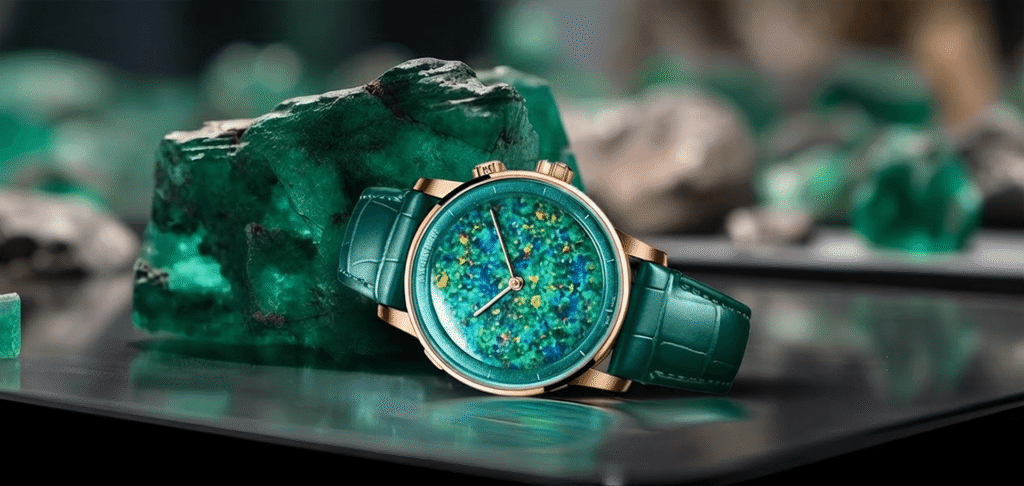
Stone dials and textured surfaces serve that interest directly. A malachite dial does not look like any other malachite dial. Natural stone varies by formation, colour distribution, and veining in ways that cannot be perfectly replicated. The same is true for meteorite, tiger’s eye, and aventurine. When a collector owns one, they own something genuinely singular, which is increasingly rare in a market where high-volume production has made many references feel interchangeable.
This move toward material individuality is also a response to maturity in the buyer base. The Dubai collector who bought their first Submariner in 2015 and their first Nautilus in 2019 is now on their fourth or fifth piece. They have graduated from “which brand” to “which specific configuration,” and a distinctive dial is a strong answer to that latter question.
What the 2026 watch fairs are showing
Geneva Watch Days, running 2 to 6 September 2026, has been the clearest single event for this trend. Among the most discussed pieces are a Gérald Genta golden obsidian minute repeater in 40mm yellow gold, three Gérald Charles Masterlink Atelier editions with hand-hammered Maillechort dials, and continued Bulgari movement in ultra-thin design with texture-forward finishes.
The golden obsidian minute repeater from Gérald Genta illustrates why independents often lead this kind of experimentation. Large brands need commercial volumes that constrain how unusual they can make a dial. A smaller maker can use a material like golden obsidian, which has optical depth that changes completely depending on the angle of light, because they are producing in limited numbers for buyers who are specifically seeking that kind of individuality.
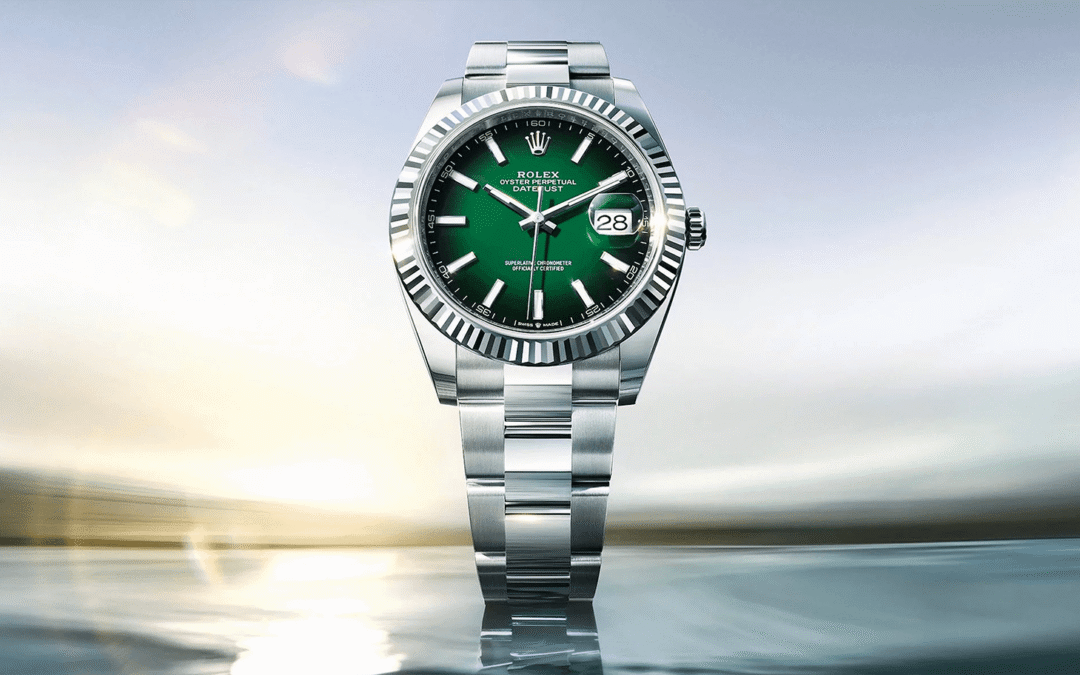
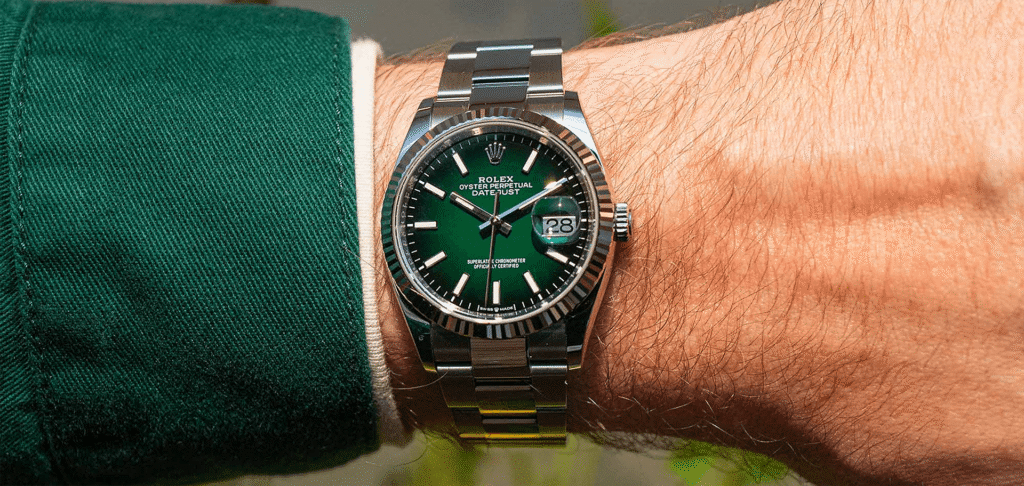
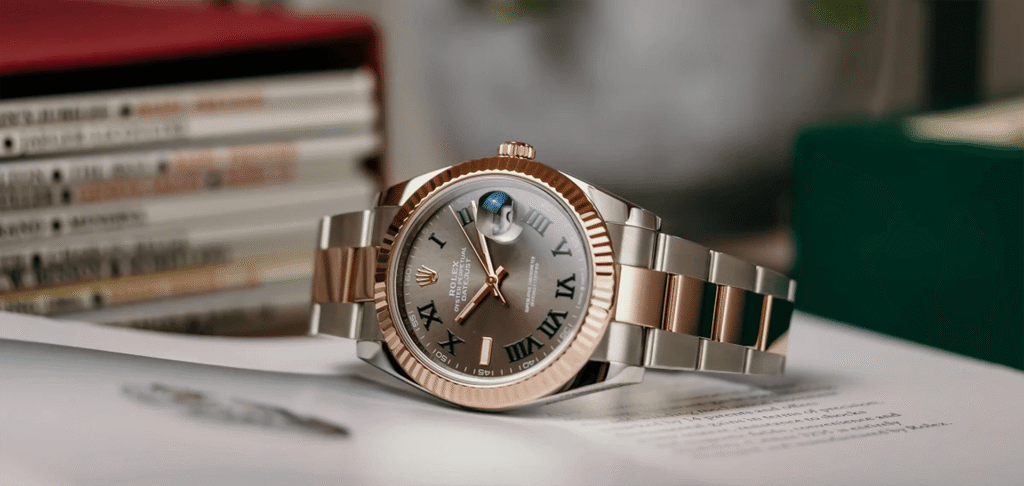
Watches and Wonders earlier in 2026 showed the major houses moving in the same direction, though with characteristic caution. Rolex’s green ombré lacquer dial on the Datejust 41 is the most significant example: it is technically complex, requires a lacquering process that has been refined since the ombré technique returned in 2019, and represents a meaningful statement from a brand that changes dial treatments rarely and deliberately.
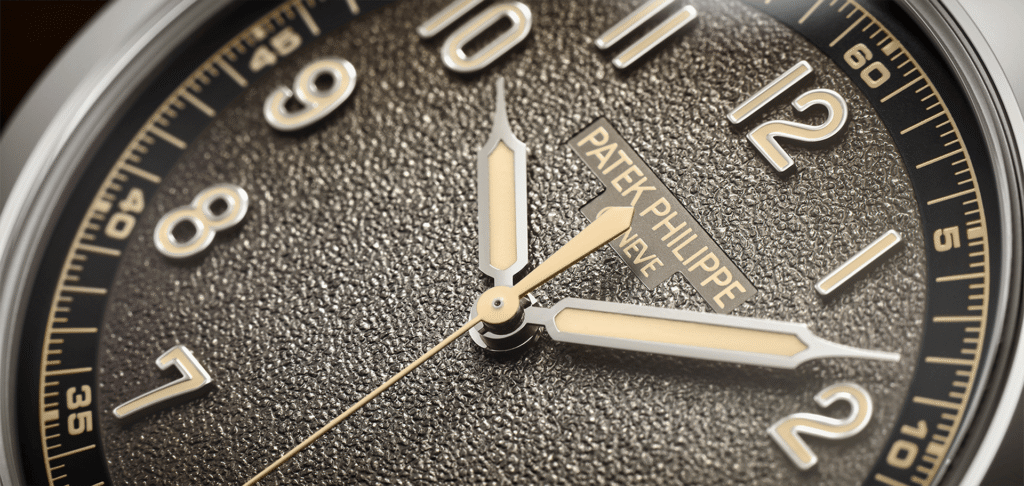
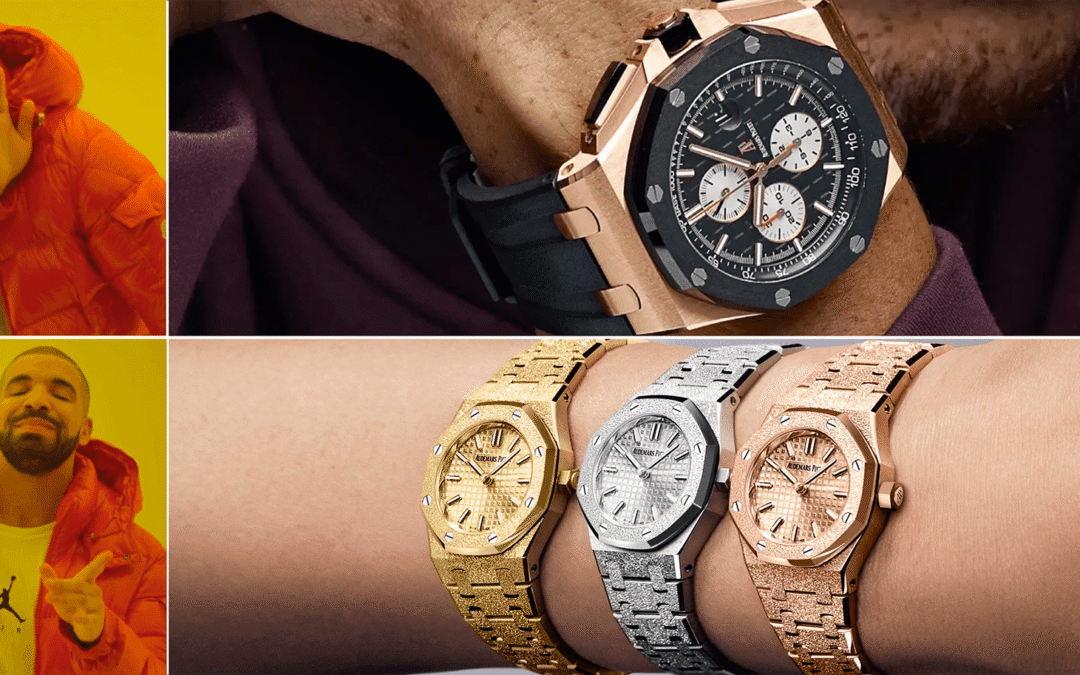
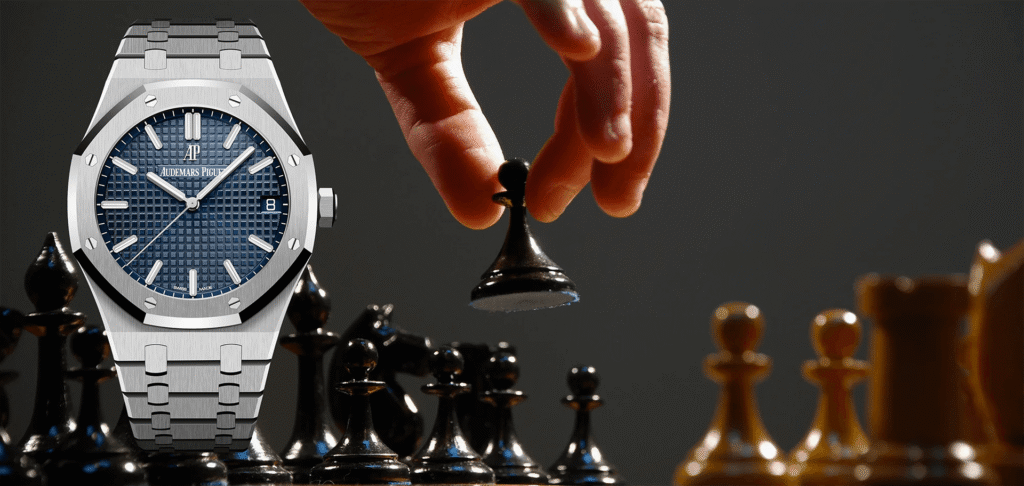
Patek Philippe and Audemars Piguet have both extended their hard enamel and tapisserie dial programs, confirming that texture is not a passing novelty but a genuine direction the industry’s most established makers are committing to for the medium term.
Stone dials explained
A stone dial is exactly what the name suggests: a watch dial cut, shaped, and finished from a natural mineral rather than a manufactured metal or lacquer base. The most common stones used in high watchmaking include malachite, lapis lazuli, onyx, aventurine, tiger’s eye, meteorite, turquoise, and hardstone composites. More unusual examples include golden obsidian, sodalite, and sunstone.
What makes stone dials different from other unusual dials is inherent variation. No two pieces of malachite have the same green swirl pattern. No two slices of meteorite show the same Widmanstätten crystalline structure. This means that when a watchmaker produces a stone dial edition of even five hundred pieces, each piece is individually distinct in a way that painted, lacquered, or printed dials are not.
There are practical considerations buyers should understand. Stone dials are more fragile than metal dials. A sharp impact that a metal dial absorbs can crack a stone dial. This does not make stone dial watches unwearable, but it is a reason to think about how and where you wear the piece. Stone dials also cannot be perfectly matched if damaged: a replacement dial cannot be cut from an identical piece of stone, which affects both the cost and possibility of dial restoration.
The fragility argument is often overstated by buyers who are hesitant about stone dials. A watch worn with normal care in professional and social settings faces very little risk. The consideration is more relevant for buyers thinking about an active daily wear piece that will encounter hard surfaces regularly.
Green is no longer a trend colour
Green entered the luxury watch conversation as a fashion moment around 2019 and 2020. In most categories, a colour that enters as a trend exits within two to three years. Green in luxury watches has not followed that pattern.
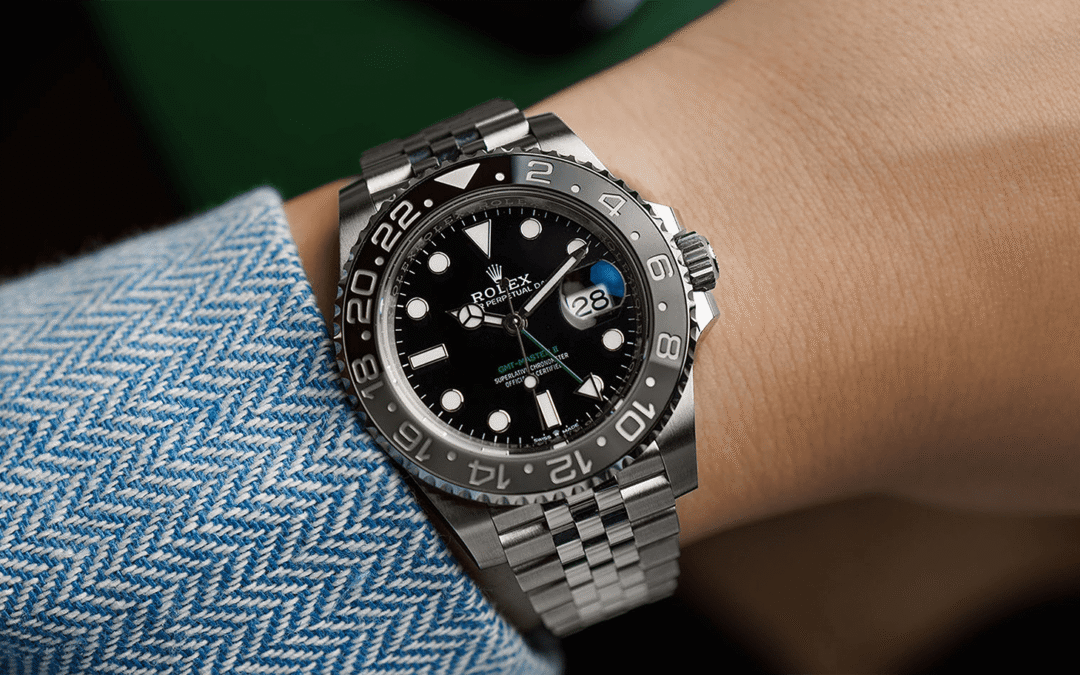
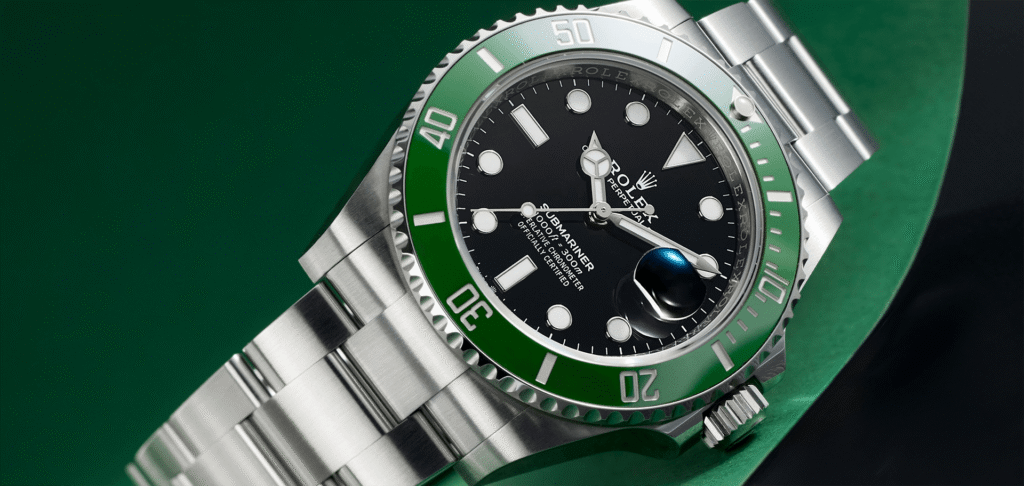
The reason is that green absorbed into the DNA of the references that wore it. Rolex green has specific associations with Oyster Perpetual models that created genuine collector demand. The Submariner “Starbucks” with its green bezel insert became one of the more liquid references in Rolex’s lineup. The GMT-Master II “Sprite” with its black and green cerachrom bezel has traded at premiums that confirm collectors are not treating it as a novelty.
Rolex’s 2026 Datejust 41 with a green ombré lacquer dial extends that logic. An ombré dial, where the colour graduates from deep at the centre to lighter at the edge or vice versa, is technically more demanding than a flat colour dial because the lacquering process requires precise control across the full surface. Rolex does not introduce this kind of technical variation unless they intend it to define the reference, which is a reasonable signal for buyers evaluating long-term dial desirability.
The collector verdict on green as a sustained colour is now reasonably clear: it has moved from trend to established. That does not mean every green dial watch is a strong purchase. It means the green dial question has graduated from “is this a passing colour” to the more relevant “is this specific reference, in this specific condition, a strong buy.”
The five questions to ask before paying a premium for a distinctive dial
These questions apply equally to a stone dial, an ombré lacquer, a meteorite face, or any dial treatment that carries a price premium over the standard reference.
1. Is the reference desirable even without this dial?
A distinctive dial can add genuine value to a strong reference. It cannot rescue a weak one. If the base watch, stripped of its unusual face, would not be a compelling purchase in its standard configuration, the dial is covering for underlying weakness rather than adding to underlying strength. Start with the reference. Evaluate the dial second.
2. Is the dial factory original?
Aftermarket dial modifications exist across the watch market and are especially prevalent in references where an unusual dial creates a significant price premium. An aftermarket modification can involve replacing a standard dial with a stone or lacquered surface, or applying treatments to an original dial that were not part of the manufacturer’s specification. The practical test is authentication: any unusual dial should be verifiable against the watch’s serial number, papers, and manufacturing period. WatchX inspects dial originality as part of its standard pre-purchase process, and the authentication service is available for buyers who want an independent assessment.
3. Is the dial production limited or merely new?
A stone dial on a new reference from a major house is not automatically scarce. Some stone dial editions run to hundreds of pieces. Others are genuinely limited to double-digit numbers. The distinction matters because scarcity is one of the drivers of secondary market premium. A stone dial edition of five thousand pieces will be traded very differently from a stone dial edition of fifty. Find out the production numbers before attributing rarity value to any specific dial.
4. Does the watch come with correct papers, service history, and condition?
This applies to every pre-owned watch, but it applies with extra weight to unusual dial pieces because the dial premium is meaningful and the provenance of that premium needs to be verifiable. A stone dial Rolex or Patek without papers is not only harder to sell: it is harder to authenticate as a genuine factory configuration, which is the fundamental question for any buyer paying above the standard reference price.
5. Can you live with this dial after the launch excitement fades?
This is the question that separates collectors from buyers who are following coverage. A stone dial that reads clearly at a normal arm distance, does not require explanation, and functions as a daily or regular-wear piece is a different long-term proposition from a stone dial that works as a photography subject but reads as confusing in person. Look at the watch in a normal indoor light setting, not only in the launch imagery. The launch photographs are shot to maximise the stone’s drama. Your wrist is not a studio.
Which dial types are likely to age best
This question cannot be answered with certainty, and any guide that offers guarantees about future collector values should be read with scepticism. What can be offered is a framework based on observable patterns in the pre-owned market.
Classic hardstones on established precious metal references have shown consistent long-term collector interest. A malachite dial on a yellow gold Patek or an onyx dial on a white gold Rolex can be found in historical auction results that reflect sustained demand across multiple decades. The combination of material rarity, precious metal case, and strong underlying reference creates multiple layers of desirability that tend to hold.
Dial colours tied to a historically significant reference accumulate collector interest over time. The Paul Newman Daytona dial was not considered especially desirable in the decades after it was produced. Collector attention built slowly, then dramatically. This does not mean every unusual historical dial will follow the same path, but it demonstrates that time and collector focus can build value in references that were initially unremarkable.
Understated textures on recognisable models tend to age better than loud novelty treatments on the same models. A brushed sunray dial, a hand-guilloche surface, or a deep lacquer finish with restrained colour on a well-known reference accumulates desirability because it adds craft without departing from the character of the watch. Loud novelty treatments can create initial hype and then become period pieces in a way that limits their long-term appeal.
Limited editions with transparent production numbers and genuine technical or material distinction age better than marketing-led editions where the limitation is stated but not meaningfully connected to the dial’s qualities.
Which dial choices require more caution
Trend colours without a strong underlying reference are the clearest caution zone. A colour that entered the market because a single brand made it popular, applied to a reference that has no particular collector standing on its own, is not a reliable purchase on investment grounds. Enjoy it for aesthetic reasons if it appeals, but price it accordingly.
Aftermarket modified dials are a risk that is disproportionately common in the stone dial and unusual dial category because the modification can be visually compelling and the premium significant. If you cannot verify the provenance of the dial treatment through papers, serial number correlation, and inspection, the dial should be priced as a standard reference until it can be verified.
Non-factory stones applied to otherwise standard references are a related risk. A watch that has had its original dial replaced with a stone surface has its value as a factory watch significantly affected. It can be an appealing object, but it is not the same commercial proposition as a factory stone dial configuration.
Watches where the price premium is not explained by scarcity, underlying reference quality, material rarity, or documented collector demand are the general caution. If the sole argument for a premium is “this dial is popular right now,” that is the least durable of all the reasons to pay more.
How this plays out in Dubai’s pre-owned market
Dubai buyers encounter more unusual pre-owned pieces than buyers in most other markets because the city’s concentration of wealth and its position as a trading hub means that globally scarce references circulate here more frequently than in smaller or more restricted markets. That is an advantage, but it comes with a corresponding responsibility to evaluate what you are seeing correctly.
The practical guidance for Dubai buyers considering an unusual dial piece in the pre-owned market:
Check dial originality specifically, not only general condition. A watch that looks correct in photographs can have a non-factory dial that only becomes apparent on close inspection or under watchmaker’s tools.
Compare the exact reference. A Rolex Datejust with a meteorite dial on a steel bracelet is a different secondary market proposition from the same dial configuration on a gold Oyster band. The bracelet, case material, and reference year all affect value in ways that are sometimes larger than the dial itself.
Request authentication, not only inspection. Inspection confirms condition. Authentication confirms that the dial configuration is genuine and corresponds to the watch’s original specification. The two are different services.
Consider the future resale audience before paying a significant premium. An unusual dial watch is not universally desirable. Some buyers specifically want unusual dials. Many buyers want the standard configuration of a reference. If you pay a significant dial premium, understand that your future buyer also needs to see the value in that specific configuration.
The full pre-owned collection at WatchX is inspected and priced with dial originality confirmed as part of the standard process. For buyers evaluating a specific unusual dial piece elsewhere, the WatchX authentication service provides independent assessment.
Frequently asked questions
Are stone dial watches trending in 2026?
Yes. Stone dials were among the most discussed features at both Watches and Wonders 2026 and Geneva Watch Days 2026. Materials including golden obsidian, malachite, aventurine, and meteorite appeared across multiple brands and price categories. The trend reflects a collector interest in individuality and craft rather than a single seasonal colour preference.
What is a stone dial watch?
A stone dial watch uses a slice of natural mineral, cut and shaped to fit the watch case, as the dial surface instead of a manufactured metal or lacquer base. Common stone types used in high watchmaking include malachite, lapis lazuli, onyx, meteorite, aventurine, and tiger’s eye. Because natural stone varies inherently, no two stone dial watches are identical even within the same reference edition.
Do stone dial watches hold their value?
Value retention depends on the underlying reference, the production numbers of the stone dial edition, dial originality, condition, and documentation. Classic hardstones on established precious metal references from Rolex, Patek Philippe, and Audemars Piguet have historically shown strong secondary market interest. Stone dial treatments on references with limited independent collector standing are not guaranteed to retain a price premium after launch attention fades. Condition of the stone dial itself is particularly relevant because damage to a natural stone dial cannot be easily repaired or matched.
Are green dial watches still popular in 2026?
Yes. Green has demonstrated unusual staying power as a luxury watch colour. Rolex’s 2026 green ombré lacquer Datejust 41, the continued trading strength of references like the Submariner “Starbucks” and the GMT-Master II “Sprite,” and Patek Philippe’s extensions of green dial variants all confirm that green has moved from trend colour to established palette. That said, the reference matters more than the colour: a green dial on a strong reference is a different proposition from a green dial on a weak one.
How do I know whether a luxury watch dial is original?
Dial originality can be verified through a combination of methods: correlating the dial configuration with the watch’s serial number and manufacturing period, checking against the original papers where available, and having the watch inspected by an experienced watchmaker who can assess whether the dial condition, printing, and finishing are consistent with factory specification. Aftermarket dial modifications are sometimes very well executed and not identifiable without professional examination.
Are aftermarket dials bad for resale value?
Yes, significantly. A watch with an aftermarket modified dial is not the same collector proposition as a factory original configuration, even if the aftermarket dial is technically superior in some respects. Buyers who specifically want factory original configurations, which is most serious collectors, will price a non-factory dial as a deduction from standard reference value rather than as an addition. The premium paid for an unusual aftermarket dial is typically not recoverable in the secondary market.
Which Rolex dial colours are most collectable in 2026?
The most reliably collectable Rolex dial colours in Dubai’s pre-owned market are those tied to specific established references with a history of collector demand: Submariner black and green, GMT-Master II red and blue (Pepsi), black and blue (Batman), and black and green (Sprite). Among less common dial treatments, the Datejust’s range of sunburst and ombré dials in steel or gold references with desirable bracelets have shown increased collector attention. The newer green ombré lacquer Datejust 41 from 2026 is generating interest but is too recent to have an established secondary market track record.
Should I pay more for a rare dial watch in Dubai?
Only if the premium is justified by the specific combination of reference quality, dial originality, production scarcity, condition, and complete documentation. A rare dial on a weak underlying reference, or a dial claimed to be rare without verifiable production information, is not a reliable basis for a price premium. Dubai’s pre-owned market is active and competitive: genuinely rare factory configurations are available, but so are pieces where the pricing reflects hype rather than substance.
WatchX is a certified pre-owned luxury watch dealer based in JLT, Dubai. WatchX is not an authorised retailer for any brand referenced in this article.
The smaller watch shift in 2026 is not a reaction to trends or social media. It is a correction driven by collectors who have spent years wearing large sports watches and have quietly decided they want something different. Across Watches and Wonders 2026 and Geneva Watch Days, the most discussed launches were not in the 42mm to 44mm range. They were at 35mm, 37mm, and 39mm. Brands that have built reputations on oversized cases are introducing more compact references because the buyers are asking for them. This guide explains what is driving that shift, which references make sense for different buyers in Dubai, and how to choose a size that works for the way you actually live.
The era of bigger being better is ending
For roughly fifteen years, the dominant logic in luxury watch buying was more size, more presence, more dial. A 44mm Royal Oak Offshore read as ambition. A 42mm Submariner Date read as taste made visible. In Dubai, where watches operate partly as social signals in high density luxury environments, that logic had real commercial pull.
That pull is weakening. It is not disappearing, but the category of informed buyer has shifted. The collectors who drove the oversized sports watch market in its peak years between 2018 and 2022 are now, in many cases, the same people buying quieter, better proportioned pieces. They have already owned the statement. Now they want something that lives on the wrist rather than announces it.
The correction is visible in the secondary market too. Not in collapsing prices for the classic references, which remain strong, but in a broadening of what sells well. The RolexDatejust 36, the Cartier Santos Medium, the smaller Patek Nautilus variants, the 37mm Royal Oak versions: all of these are trading with increased activity in Dubai’s pre-owned market in 2026.
What the 2026 watch fairs are telling us
Geneva Watch Days, running from 2 to 6 September 2026, has reinforced the trend at an industry level. Among the most discussed launches are a Bulgari Octo Finissimo at 37mm, a Gérald Charles Masterlink Atelier in 38mm, and a new Bremont Terra Nova Jumping Hour at 35mm. These are not the same brand making a smaller version of an existing watch. They are three different makers, across different market positions, all arriving at a compact diameter as the right expression for 2026.
Watches and Wonders earlier in the year told a similar story. The major houses were not introducing larger references as headline pieces. They were introducing refinement: new movements in existing cases, new dials on proven proportions, and a return to case shapes that prioritise how a watch wears rather than how much space it takes on the wrist.
This is a meaningful industry signal. When both the established brands and the independent makers at Geneva Watch Days are moving in the same direction, the question is no longer whether the trend is real. It is what to do with it.
Why this matters specifically in Dubai
Dubai collectors operate across more contexts per day than buyers in most other cities. The morning might be a business meeting in DIFC. Lunch is a client hospitality setting. The afternoon involves travel. The evening is a social dinner or a family occasion. The watch on the wrist needs to work across all of those without being a decision each time.
A 42mm Submariner with a rubber bezel insert is a strong choice for some of those contexts and a noticeably wrong one for others. A 36mm Datejust in steel slides under a shirt cuff, photographs without dominating, works in a formal restaurant without creating a conversation you did not want, and travels without the self-consciousness of wearing something that demands attention.
The heat argument is also real, though it is not absolute. Steel bracelets in Dubai summers are not impossible, but they are not comfortable either. Lighter, more compact watches in leather, rubber, or fabric options become more appealing in a climate where your watch is on your wrist in 40-degree heat for months of the year.
None of this means the Submariner or the Offshore is the wrong watch. It means the compact watch earns its place differently, and more Dubai buyers are now building collections that include both.
The best compact references for different buyers
The buyer who wants one Rolex for everything
Rolex Datejust 36
The Datejust 36 is probably Rolex’s most balanced proportion. It is not a field watch, not a dress watch, and not a sports watch. It is a watch that does not require categorisation. The 36mm case sits cleanly on most wrists, the Jubilee bracelet adds just enough formality, and the range of dial options means buyers can choose something restrained or something with a bit of personality.
Against the Datejust 41, the 36 reads as more considered, less casual, and more versatile across dress contexts. The 41 has more visual weight and a slightly sportier personality because of the larger case and longer lugs. Neither is universally right. The choice comes down to whether the buyer wears this watch primarily in professional settings or in more relaxed ones. For professional daily wear in Dubai, the 36 usually wins the argument.
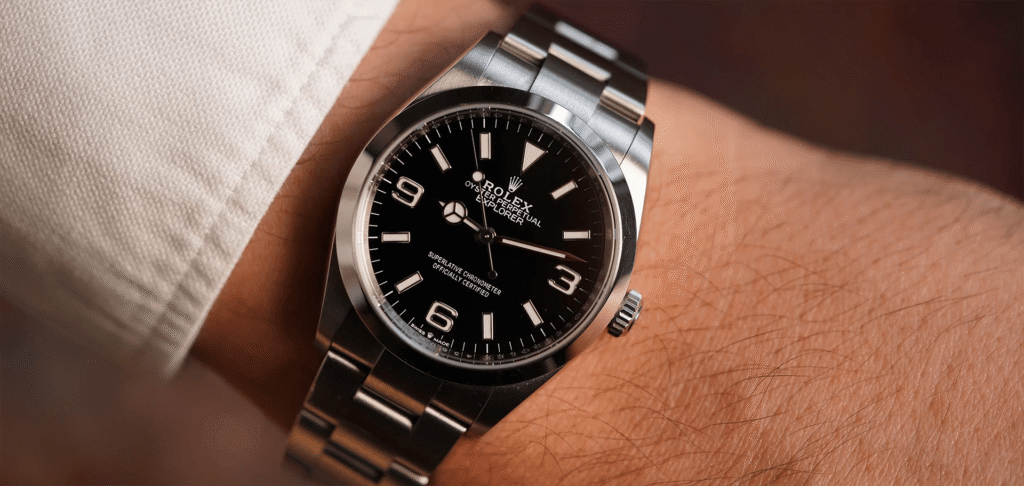
The Explorer 36, in its current 124270 iteration, is a quiet collector piece that often gets overlooked by buyers focused on the GMT-Master II or the Submariner. It has a 36mm Oyster case, no date complication, and one of Rolex’s clearest dial designs: black, with 3, 6, and 9 in Arabic numerals and a seconds hand in orange on some references. There is nothing surplus to the design.
For the buyer who wants Rolex recognition without the visual weight of a Submariner, and without the GMT buyer’s wait list conversation, the Explorer 36 is a strong argument. It trades well in the secondary market and rarely suffers from the extreme price volatility that the more popular references see.
The buyer who wants quiet luxury
Cartier Santos Medium
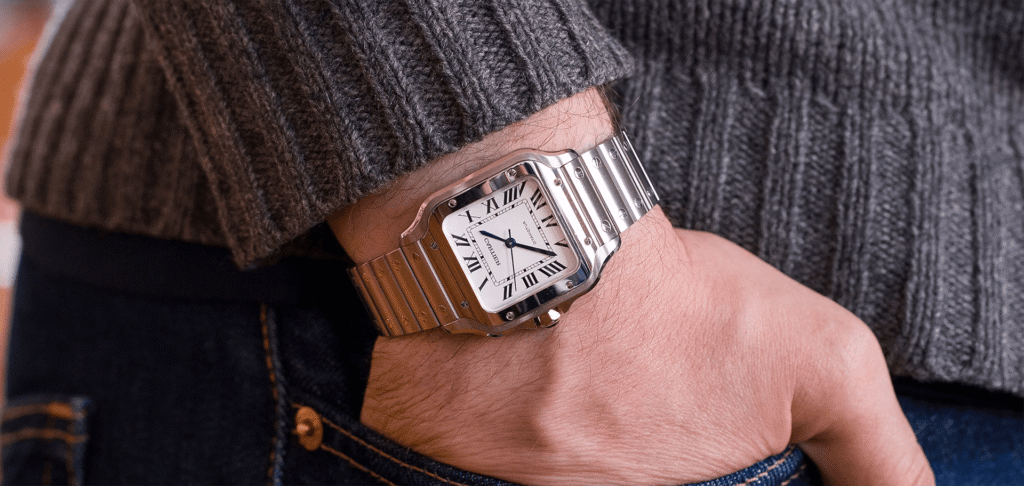
The Cartier Santos Medium is one of the most underrated compact luxury watches available in Dubai’s pre-owned market. Its square case means it wears larger than the diameter suggests, because the case occupies more horizontal wrist space than a round watch at the same measurement. A Santos Medium at 35.1mm reads on the wrist more like a 38mm round watch.
The Santos is also historically significant. It was designed in 1904, making it the first purpose-built wristwatch. That context matters for buyers who want something with depth behind it. In pre-owned form, a Santos Medium in steel in excellent condition with papers can be found at a price point that represents genuine value against the current retail.
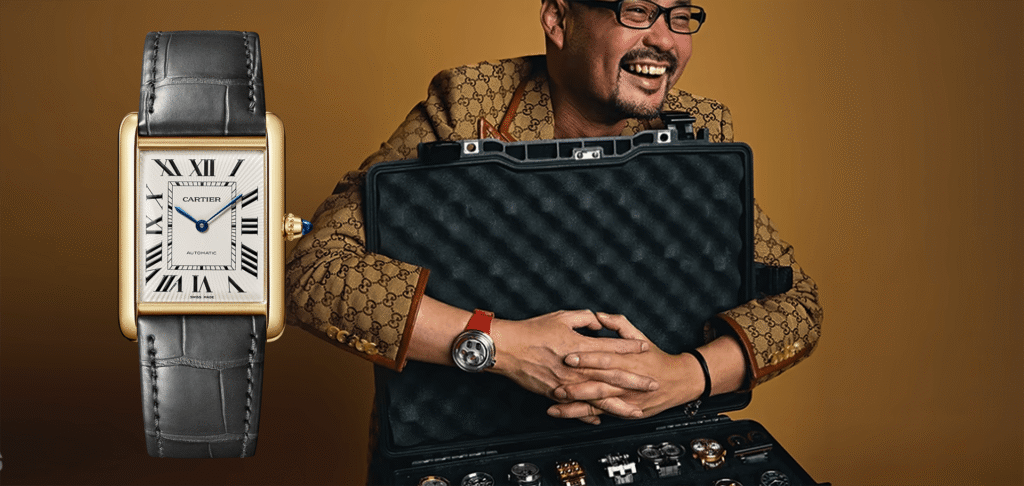
Cartier Tank Louis
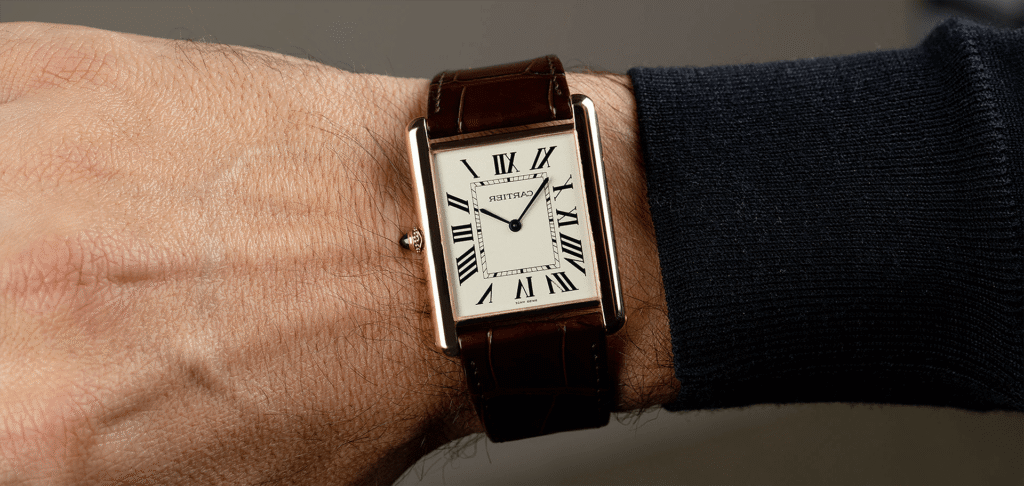
The Tank occupies a different position. It is a dress watch, not a daily sport or professional piece, but it belongs in this conversation because it demonstrates why diameter alone does not determine the character of a watch. A Tank Louis at 33mm can have more visual authority on a suited wrist than a 42mm sports watch that reads as off-register in a formal context.
For the buyer who wants to make a considered choice rather than an obvious one, the Tank is worth serious attention. The Cartier collection at WatchX includes both Santos and Tank references.
The buyer who wants an integrated bracelet watch
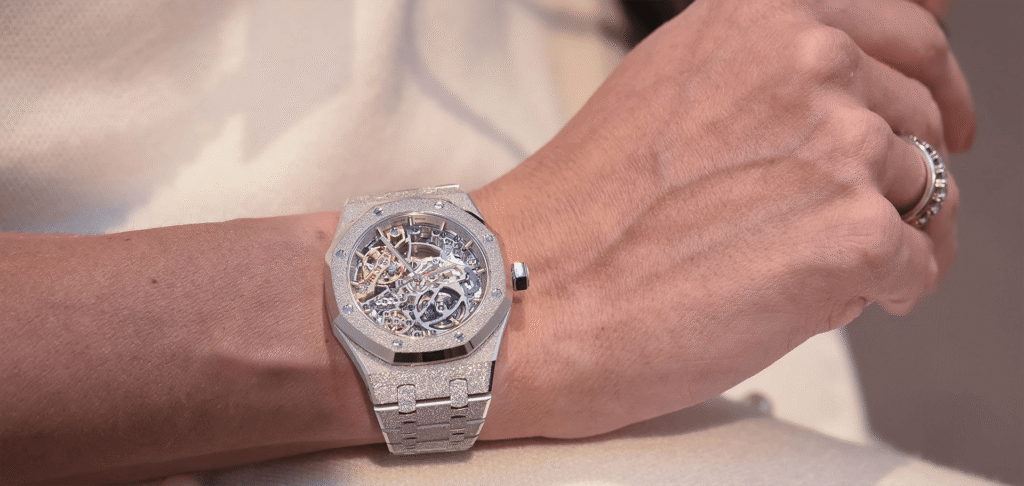
Audemars Piguet Royal Oak 37mm
A Royal Oak at 37mm is a watch that surprises most buyers when they try it on. The integrated bracelet, which spans the full width of the case and flows into the wrist, gives it more presence than the number implies. The octagonal bezel with its eight screws is as visually distinctive at 37mm as it is at 41mm. What changes is how the watch sits on the wrist, and for a significant number of buyers, the 37mm version sits better.
The Royal Oak 37mm is particularly strong for buyers who are running the watch in more formal or office-facing contexts. It carries all of the Royal Oak’s design authority without the bulk of the larger references. In Dubai’s pre-owned market it trades with strong liquidity because the design has a broad buyer base globally. The Audemars Piguet collection at WatchX includes Royal Oak references across sizes.
The buyer who wants a compact sports watch
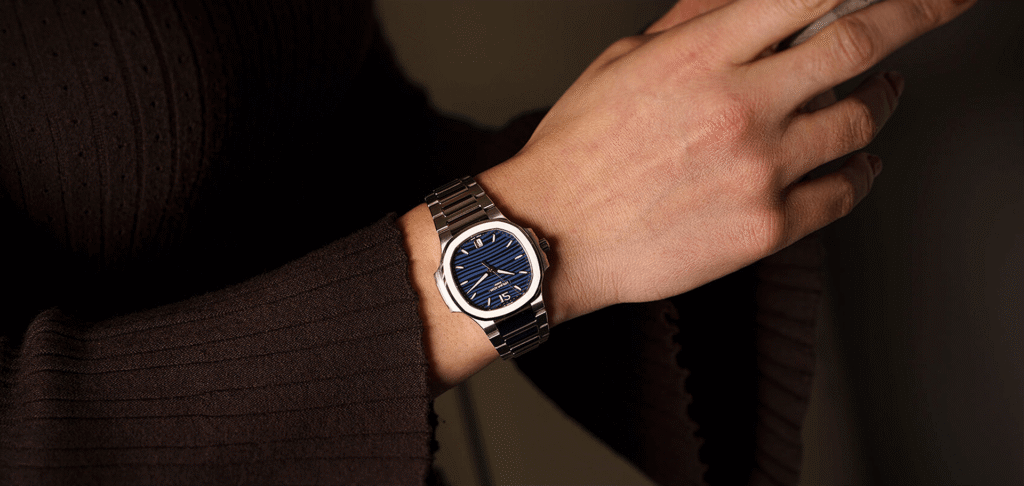
Patek Philippe Nautilus 7118 and Aquanaut
The Nautilus 7118 at 35.2mm was described in our luxury watch archetypes guide as a piece increasingly sought by collectors who want the Nautilus design in a more manageable proportion. That demand has continued to grow through 2026.
The Aquanaut in smaller variants makes a similar case for buyers who want the sporty, rubber-strapped identity of the Aquanaut without the 40mm-plus footprint of the standard 5167. Both Patek sport references reward buyers who have done their research. They are complex pieces to evaluate correctly in the pre-owned market, which makes the source and documentation of the piece especially important. The full Patek Philippe range at WatchX includes both families.
The buyer who wants a dress watch with collector credibility
The Cartier Tank, the Datejust 36 with a sunburst dial, and the Patek Nautilus 7118 all occupy different points on the spectrum from casual to formal. What they share is that each carries genuine collector interest independent of current market hype, which is the quality that matters most for buyers who are thinking five to ten years ahead rather than five to ten months.
How to choose the right size before buying pre-owned
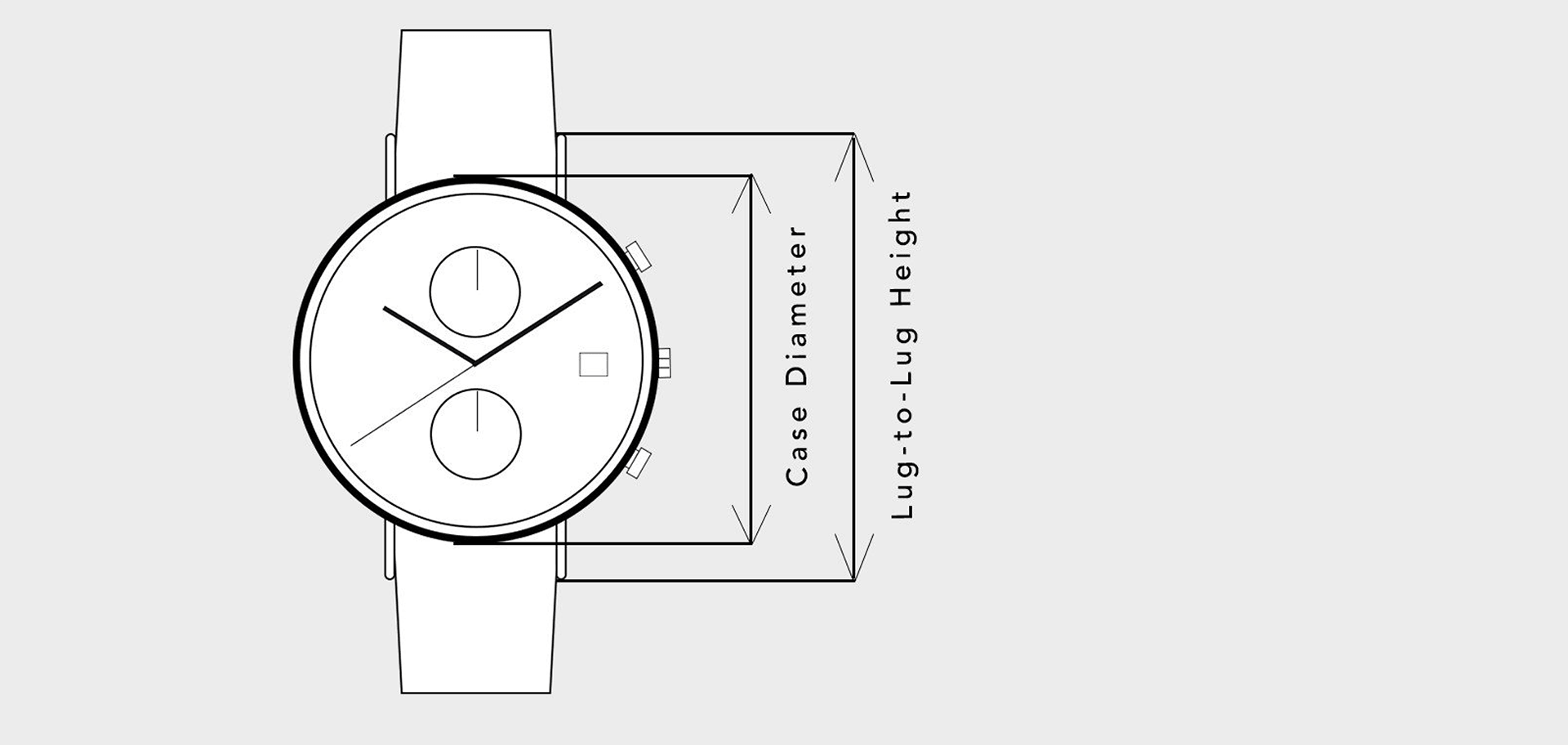
The most reliable advice here is simple: try it before you decide. A reference number tells you the diameter. It does not tell you the lug-to-lug distance, which is the measurement that determines whether a watch overhangs the wrist uncomfortably. It does not tell you how the bracelet weight distributes across the wrist, how the case thickness sits under a cuff, or whether the dial reads the way you expected at a normal arm distance.
Specific things to check before committing to a size:
Lug-to-lug, not only diameter. A 39mm watch with a longer lug span can wear larger than a 41mm watch with a compact, integrated bracelet. The Cartier Santos Medium illustrates this clearly.
Case shape and bracelet integration. An integrated bracelet watch, where the bracelet flows directly from the case without a gap, sits differently on the wrist than a watch with standard lugs and an attached bracelet. The Royal Oak and the Nautilus both wear closer to the wrist and with more distributed weight because of their integrated construction.
Your wardrobe. Lay your watch decision against the three or four outfit contexts you most commonly wear a watch in. A 36mm Datejust in a work shirt sleeve reads completely differently from the same watch under a casual jacket. Try both.
First watch, daily watch, or collection counterpoint. The right size for a first serious watch is not the same as the right size for a fifth piece that fills a specific gap. If you are building a counterpoint to a larger sports watch you already own, a compact dress piece might serve the collection better than another 41mm reference.
Do not choose a size because it is currently trending. Collector attention cycles. The 36mm is attracting interest now partly because the 42mm dominated for so long. Buying the right watch at the right size for your actual wrist and wardrobe is a better long-term decision than buying whatever is most discussed this September.
For buyers who want to work through this with experienced advice before purchasing, the WatchX Watch Concierge in Dubai handles exactly these kinds of decisions.
Does smaller mean better for resale in 2026?
Not categorically. Resale value is reference specific, condition specific, and documentation specific. A RolexSubmariner Date in 41mm with full box and papers in excellent condition is one of the most liquid watches in Dubai’s pre-owned market, and that is not changing because compact watches are attracting attention.
What is changing is the demand spread. A year ago, a Datejust 36 in an unusual dial combination might have taken longer to sell than a Datejust 41 in the same condition. Today, the 36 with a desirable dial moves faster than it did. That is a meaningful shift for buyers thinking about future liquidity.
The durable advice remains the same regardless of size trend. Buy a reference with genuine collector history, not only current fashion. Insist on complete documentation, box and papers, and service history where available. Buy from a dealer who inspects before pricing rather than sourcing from unknown sellers. And do not pay a size premium that is not explained by genuine scarcity in the specific reference you want.
The pre-owned collection at WatchX is updated regularly across all size categories.
Frequently asked questions
Are smaller luxury watches trending in 2026?
Yes, and the trend is visible across the industry rather than limited to one brand. Watches and Wonders 2026 and Geneva Watch Days both featured a clear move toward 35mm to 39mm references from both established houses and independent makers. Bulgari, Gérald Charles, and Bremont all launched notable compact watches at Geneva Watch Days in September 2026. The driver is collector interest in proportion and daily wearability rather than a specific fashion moment.
Is a 36mm Rolex too small for men?
No. The RolexDatejust was produced at 36mm for decades as its standard size and was worn across all genders without the sizing being considered relevant. What determines whether a 36mm watch looks right is the lug-to-lug measurement relative to wrist width, the case shape, and the bracelet. A well-chosen 36mm Rolex on a medium wrist typically
Should I buy a Datejust 36 or Datejust 41 in Dubai?
For professional daily wear and formal contexts, the Datejust 36 typically performs better. For a casual daily watch or a buyer who prefers more wrist presence, the 41 has more visual weight. Both references are well represented in Dubai’s pre-owned market with strong liquidity. The decision should come down to how the watch sits on your wrist and the contexts you most frequently wear it in, not which size is currently more discussed.
What are the best luxury watches under 40mm in 2026?
Several references stand out for Dubai buyers. The RolexDatejust 36 and Explorer 36 are the clearest Rolex arguments. The Cartier Santos Medium and Tank Louis are strong compact choices with historical depth. The Patek Philippe Nautilus 7118 is the compact sports watch reference with the strongest collector following. The Audemars Piguet Royal Oak 37mm carries full Royal Oak design authority in a more wearable proportion. All of these are available in Dubai’s pre-owned market with the right sourcing.
Why does a Cartier Santos Medium wear larger than its size?
The Santos Medium has a square case rather than a round one. A square case covers more horizontal wrist area than a round watch at the same measured diameter because the corners extend into the corners of the wrist space. The Santos at 35.1mm occupies the wrist roughly as a 38mm round watch does. The integrated bracelet also contributes: because it connects flush to the case, the watch appears longer on the wrist than a round case with standard lugs.
Is a 37mm Royal Oak a good everyday watch?
Yes, for most contexts. The Royal Oak 37mm carries the same octagonal bezel and integrated bracelet as the larger references, which means it has the same visual identity and design authority. Its lighter weight and more compact footprint make it more comfortable for extended daily wear, particularly for buyers with smaller wrists or those who wear a watch in formal settings more often than casual ones. It trades well in Dubai’s secondary market because the Royal Oak has a deep global buyer base.
Do smaller watches hold value better than larger ones?
Not as a general rule. Value retention is reference specific. The Rolex Submariner at 41mm is one of the most reliably liquid watches in the world’s pre-owned markets and that will not change because smaller cases are fashionable. What compact watches are doing in 2026 is attracting broader buyer demand, which improves their liquidity compared to a year ago. The safest approach is to buy a strong reference in the right size for your use, with complete documentation, rather than to chase either a size trend or a size contrarian argument.
Where can I buy certified pre-owned compact luxury watches in Dubai?
WatchX is a certified pre-owned luxury watch dealer based in JLT, Dubai. WatchX is not an authorised retailer for any brand referenced in this article.
The short answer: The best everyday luxury watch for someone who moves between a serious professional environment and a physically active or travel-heavy second life is one that handles both without asking for consideration. In Dubai’s pre-owned market, that shortlist comes down to the Rolex Submariner, the Rolex GMT-Master II, and the Cartier Santos, depending on which half of your double life you need to prioritise.
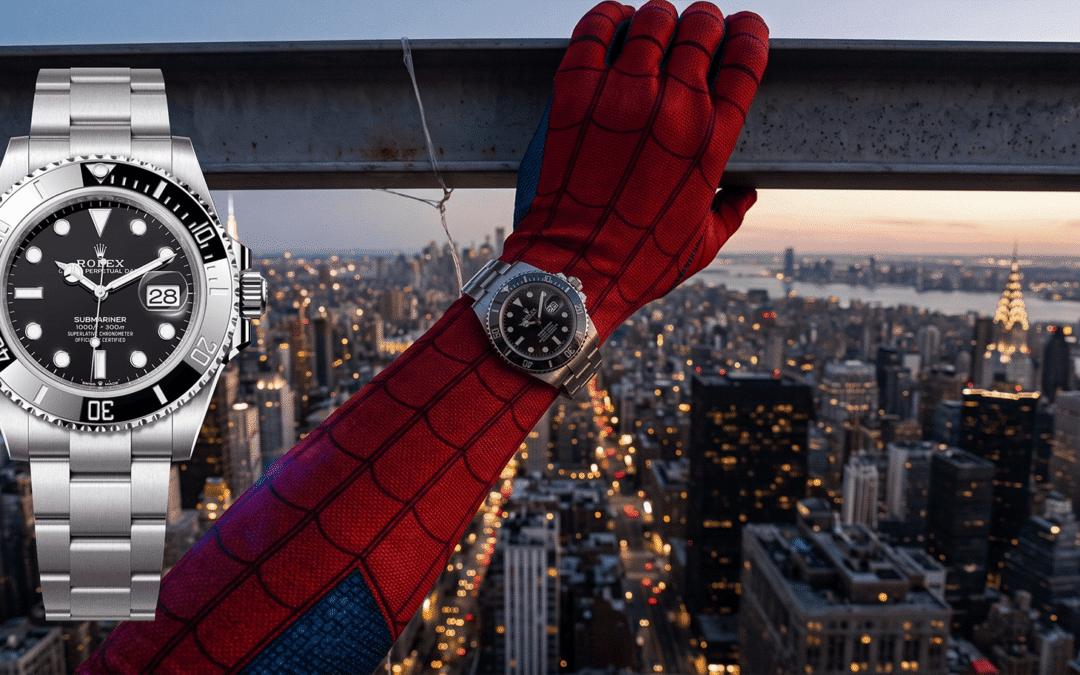
Peter Parker has a specific problem that most watch brands have not solved. He spends his mornings at a desk and his evenings doing things desks were not designed to anticipate. The watch on his wrist needs to survive both without looking like it was chosen for either.
That is not purely a superhero problem. In Dubai, it describes a significant portion of the WatchX buyer. An executive who runs early morning desert trails. A founder who flies three times a week and also trains. A collector who wears their watch to a board meeting in DIFC and a weekend dive in the Maldives. The double life is real. The question is which pre-owned references actually handle it.
This guide works through the practical answer, brand by brand, reference by reference, using real secondary market data from Dubai’s pre-owned market in August 2026.
What a Double Life Watch Actually Needs to Do
Before getting to the shortlist, it helps to be specific about the criteria. A watch that genuinely covers two very different contexts needs to do the following:
It needs water resistance that is not theoretical. A rating of 100 metres minimum covers most real-world active use. 200 metres covers almost everything.
It needs a case that handles contact. Scratches on a highly polished case are visible immediately. Brushed or satin-finished surfaces read better over time and require less consideration during wear.
It needs to move between dress and casual contexts without looking like a compromise in either. A dedicated dive watch in a board meeting reads as a choice. A dedicated dress watch at a sports event reads as an accident.
It needs to hold its value. A serious buyer in Dubai is also thinking about what the watch is worth when they decide to sell or trade it. References with strong secondary market liquidity protect that decision.
Finally, it needs to work as a single watch if that is what the buyer is running. Not everyone wants to own six pieces and rotate them. The double life watch is sometimes the only watch.
Category One: The Everyday Tool Watch
Rolex Submariner Date and No Date
The Rolex Submariner is the reference against which all other daily wear tool watches are measured. Not because of marketing, but because of what it actually does.
Water resistant to 300 metres. A unidirectional rotating bezel in cerachrom ceramic that handles knocks without showing them. A case diameter of 41mm that sits comfortably on a range of wrist sizes. An Oyster bracelet that has been refined over 70 years of production to sit, move, and open correctly. The movement, calibre 3235 in the current production model, has a power reserve of approximately 70 hours and a deviation rate of plus or minus 2 seconds per day.
In Dubai’s pre-owned market in August 2026, a Submariner Date in Oystersteel, references 126610LN or 126610LV, trades between AED 55,000 and AED 75,000 depending on year, condition, and completeness of documentation. The No Date variant, 124060, which dropped the cyclops lens and the date complication in 2020, trades slightly differently and appeals to buyers who prefer the cleaner dial.
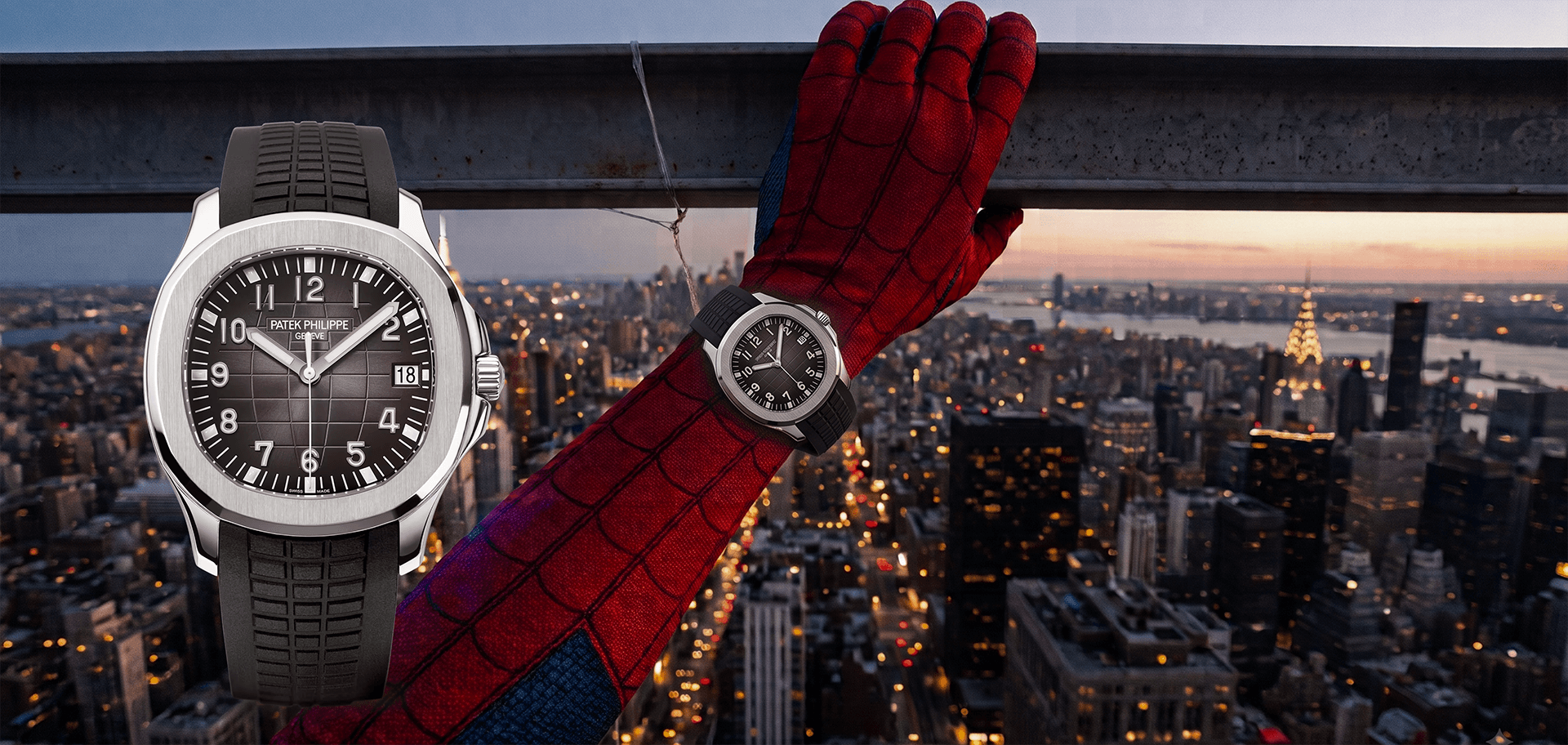
Tom Holland, who plays Spider-Man and wore a Patek Philippe Aquanaut 5167R at a recent Wimbledon appearance, makes a reasonable case study here. He also owns the Aquanaut 5168G in blue, a watch that covers similar practical ground at a significantly higher price point. The Submariner gets you most of the same utility at a fraction of the cost.
The GMT-Master II was commissioned by Pan American World Airways in 1954 for pilots who needed to track home time and local time simultaneously. The brief has not changed. For a Dubai buyer who lives in more than one time zone, this is not a complication chosen for its looks. It is the one that actually gets used.
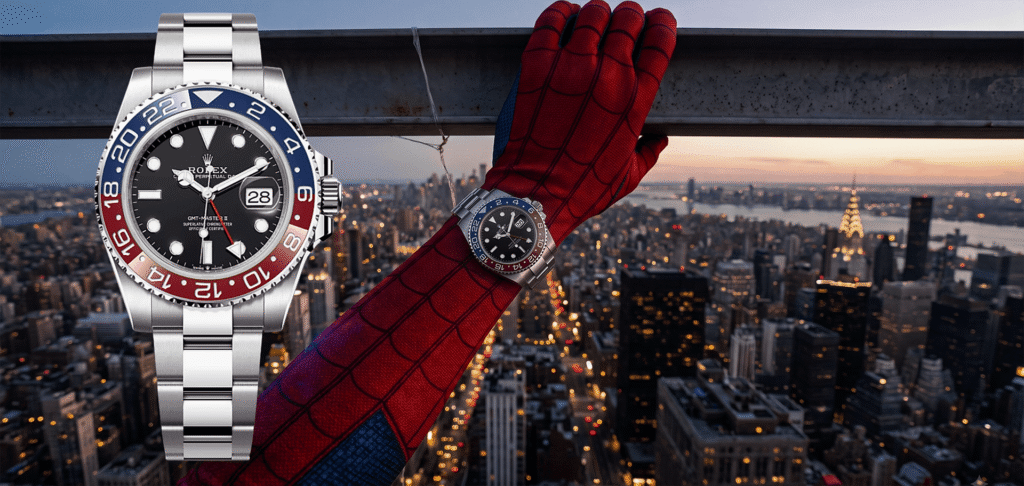
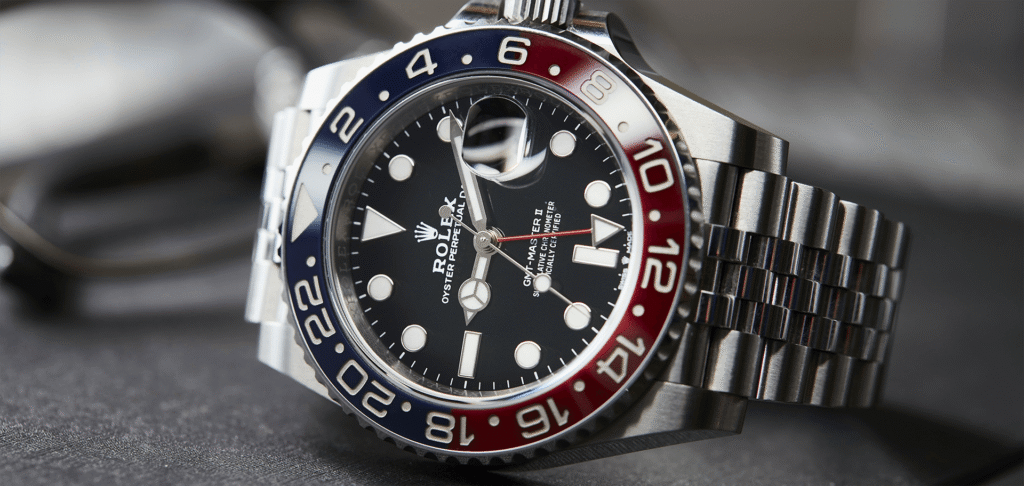
The current GMT-Master II lineup includes three references that trade regularly in Dubai’s secondary market. The Pepsi, 126710BLRO, with its red and blue ceramic bezel, is the most recognised. The Batman, 126710BLNR, with a black and blue bezel, is preferred by buyers who want the complication with a more understated reading. The Sprite, 126720VTNR, which runs a left-handed crown and a black and green bezel, trades at a premium because of its relative scarcity.
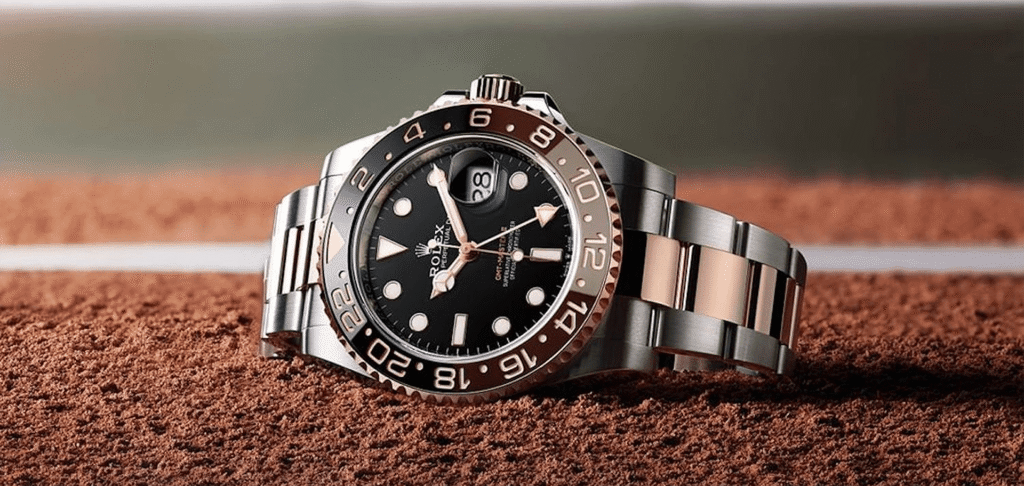
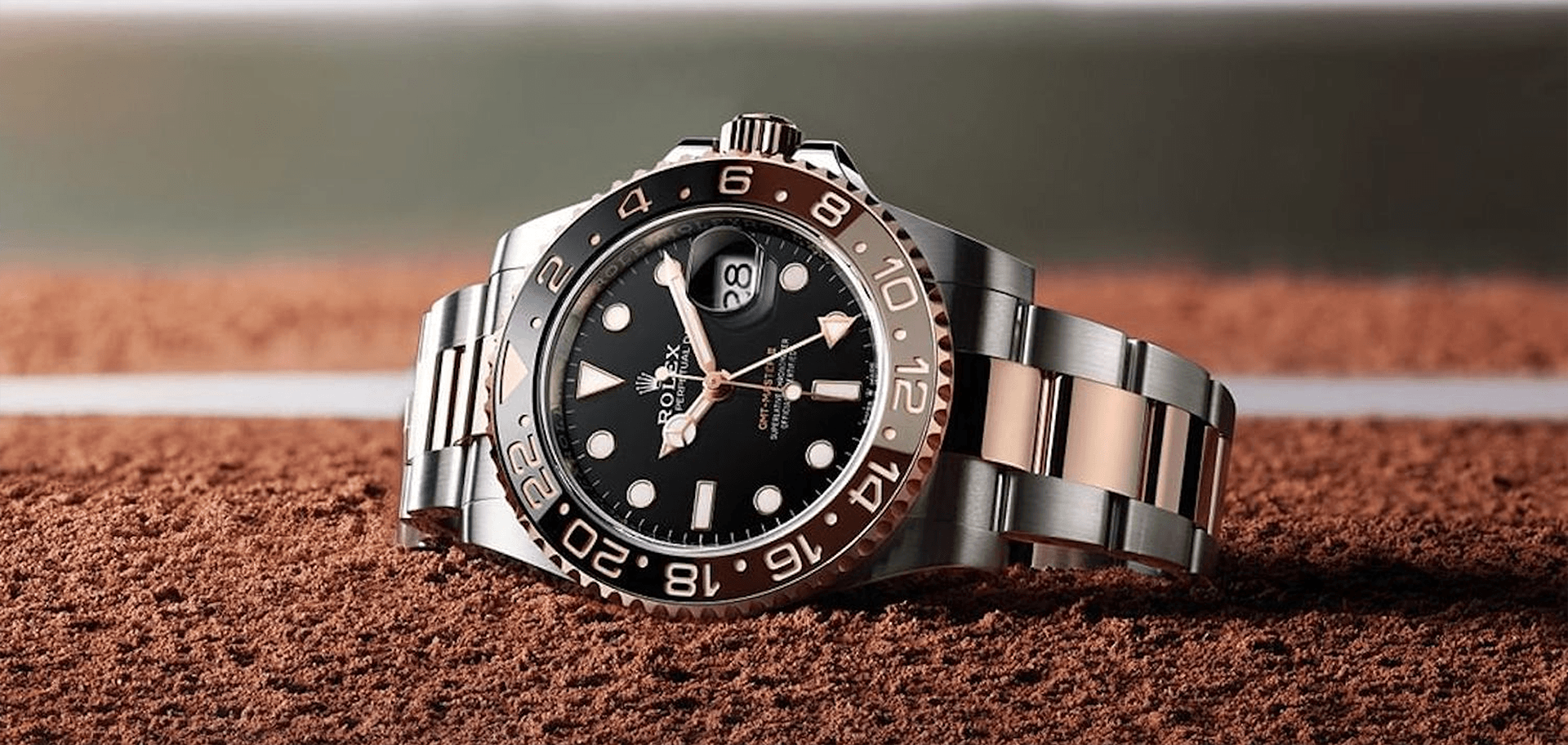
The GMT-Master II Zombie, the two-tone steel and yellow gold variant with a black and gold ceramic bezel, is currently available at WatchX for AED 77,000, reduced from AED 84,000. This is the 2026 production reference, which means full box and papers, and it covers the double life brief better than almost anything else at the price: functional GMT complication, water resistance to 100 metres, a case durable enough for daily wear, and a secondary market that has historically supported strong value retention.
For the Spider-Man buyer who is also a Voyager in the archetype sense, this is the natural crossover reference.
Category Three: The Stealth Luxury Piece
Cartier Santos
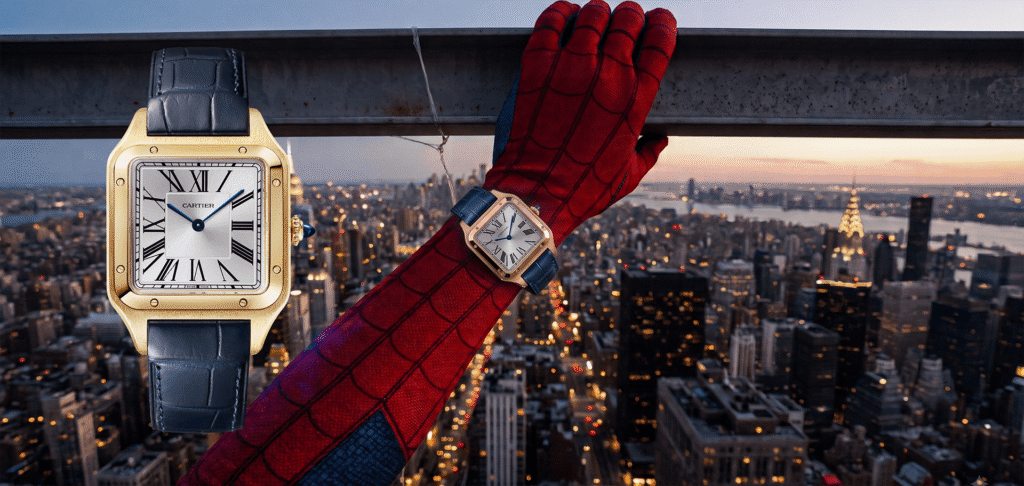
The Cartier Santos was the first wristwatch designed for everyday wear that was not adapted from a pocket watch. Louis Cartier designed it in 1904 for his friend Alberto Santos-Dumont, a Brazilian aviation pioneer who needed to check his time without letting go of the controls of his aircraft. It has been in continuous production ever since, with minor adjustments to case size and bracelet design.
What makes the Santos relevant to the double life buyer in 2026 is its position in the market. It is a serious watch, with 120 years of history and a pre-owned market that has strengthened through the quiet luxury trend of the past two years. But it does not announce itself the way a Royal Oak or a Submariner does. It sits on the wrist in a business meeting without creating a conversation you did not want to have.
The Santos in steel with a grey dial trades in Dubai’s pre-owned market at between AED 25,000 and AED 40,000 depending on size, condition, and papers. The larger WSSA0018 reference, 39.8mm, is the better daily wear case. The smaller 35.1mm reference suits buyers who want something that reads more like a dress watch.
If budget is not the primary constraint, the Aquanaut 5167A is the strongest argument for a single watch that covers both halves of a double life. It is water resistant to 120 metres, which covers most active use. Its composite case is more scratch-resistant than a polished steel case. The rubber strap is comfortable in heat, which matters significantly in Dubai. And it carries the Patek Philippe provenance, which means its secondary market liquidity is among the strongest in the industry.
In Dubai’s pre-owned market in August 2026, the 5167A trades at AED 100,000 to AED 130,000 for references from 2020 onwards with complete documentation.
Tom Holland has worn multiple Aquanaut references publicly, including the 5167R in rose gold and the 5168G in blue. For a buyer who wants the same reference with more practical daily wear credentials, the 5167A in steel is the cleaner choice.
What the Double Life Buyer Should Avoid
There are references that look correct for this brief and are not. A highly gem-set piece, regardless of brand, is not a daily wear choice for someone physically active. Not because of the cost, but because of the impracticality. Gem settings on a bezel do not survive consistent contact with hard surfaces.
Highly polished case finishes show scratches immediately and require frequent attention to look correct. If you are wearing a watch daily in a Dubai summer, a brushed or satin case is a better practical choice.
Watches with uncertain provenance are a risk regardless of how they look. In Dubai’s secondary market, box and papers are not a nice to have. They are the difference between a watch that trades well when you decide to move it and one that does not.
Dubai Context: Why This Brief Is Especially Common Here
Dubai is not a single-context city. The same person who is in a structured meeting at DIFC at 9am is at the Burj Al Arab for lunch and on a plane to Geneva by evening. The UAE’s expatriate population is one of the highest by proportion of any country in the world. The Henley and Partners 2024 UHNWI report estimated that the UAE added 6,700 high net worth individuals in 2024 alone, many of them living exactly the kind of cross-context life that makes the double life brief relevant.
Dubai’s pre-owned watch market also has a specific advantage for this kind of buyer. Waiting lists at boutiques for Submariner and GMT-Master II references are measured in years. The pre-owned market at WatchX offers the same references with full documentation, immediately available, often at prices that track within AED 5,000 to AED 15,000 of the boutique price. For a buyer who has already decided on the reference, the pre-owned route is the faster and sometimes cheaper path.
Every watch sold by WatchX is inspected and documented before it goes into the showroom. The reference verification, service history where available, and completeness of box and papers are confirmed before pricing. This matters specifically for the double life buyer because you are choosing a watch you will wear consistently, in variable conditions, over a long period. The provenance of that piece needs to be clean.
What is the best everyday luxury watch for someone highly active in Dubai?
The Rolex Submariner is the most defensible answer. It handles water, heat, and physical contact better than almost any other watch at a comparable price point, and it retains value reliably in Dubai’s secondary market. Current pre-owned pricing starts at around AED 55,000 for a recent steel reference with documentation.
Which watches handle both office and casual wear in Dubai?
The Rolex Submariner Date, the Rolex GMT-Master II, and the Cartier Santos all move between formal and casual contexts without requiring explanation in either. The Patek Philippe Aquanaut 5167A covers the same ground with stronger brand provenance at a higher price point.
Is a GMT watch necessary if I travel often?
If you regularly operate across two or more time zones, the GMT function is the most useful complication you can add to a single watch. The Rolex GMT-Master II tracks two time zones simultaneously via a 24-hour hand and a rotating bezel, which is faster and more reliable in practice than adjusting the main hands.
Should I buy a Submariner or a Cartier Santos for daily use?
They serve different briefs. The Submariner is the stronger choice for someone who needs genuine water resistance and durability as a priority. The Santos is the stronger choice for someone who wants a dress-appropriate daily wear piece with historical depth. Budget is also a consideration: the Santos enters the pre-owned market at AED 25,000, the Submariner at around AED 55,000.
Do sport and tool watches hold value better than dress watches in Dubai?
Generally, yes, at the current market moment. Rolex sport references and Patek Sport references have shown stronger value retention through the 2022 to 2024 correction than dress references in the same price bands. This is partly a liquidity effect: more buyers in Dubai’s market know these references and can move them quickly.
How do I choose my first serious everyday watch in Dubai?
Start with a clear answer to how often you will actually wear it and in what conditions. Then set a budget that includes the cost of documentation because a watch without papers trades significantly worse in the secondary market. The WatchX concierge service walks buyers through this process before any purchase is made.
Where can I buy a certified pre-owned Rolex Submariner or GMT-Master II in Dubai?
The short answer: The watch on your wrist is a character choice. If you match the reference to how you actually live rather than to what is currently hyped, you will make fewer mistakes and build a collection that holds both personal and financial value. This guide maps the six watches WatchX stocks most closely to four real buyer archetypes, using current secondary market data from Dubai’s pre-owned market.
If you have seen Christopher Nolan’s Odyssey, you already understand something about the relationship between identity and the objects people carry. Every character in that film is defined partly by what they choose and what they refuse to put down. Watches work the same way. Not as costume. Not as status signal. As a choice that says something specific about how you operate.
This is not a guide about which brand is the most prestigious. It is a guide about which references make sense for which kind of person, based on how those people actually live in Dubai and the wider GCC in 2026. The archetypes below are drawn from real buyer patterns at WatchX, based in JLT, Dubai. If one of them sounds like you, the watch pairing that follows is worth thinking about seriously.
The Four Archetypes
The Timekeeper
Who this is: Someone who runs a schedule. A CFO, a senior partner, a founder managing three time zones from a single desk. This person values precision because their work depends on it. They want a watch that looks right in a boardroom and says nothing they would have to walk back at a negotiation.
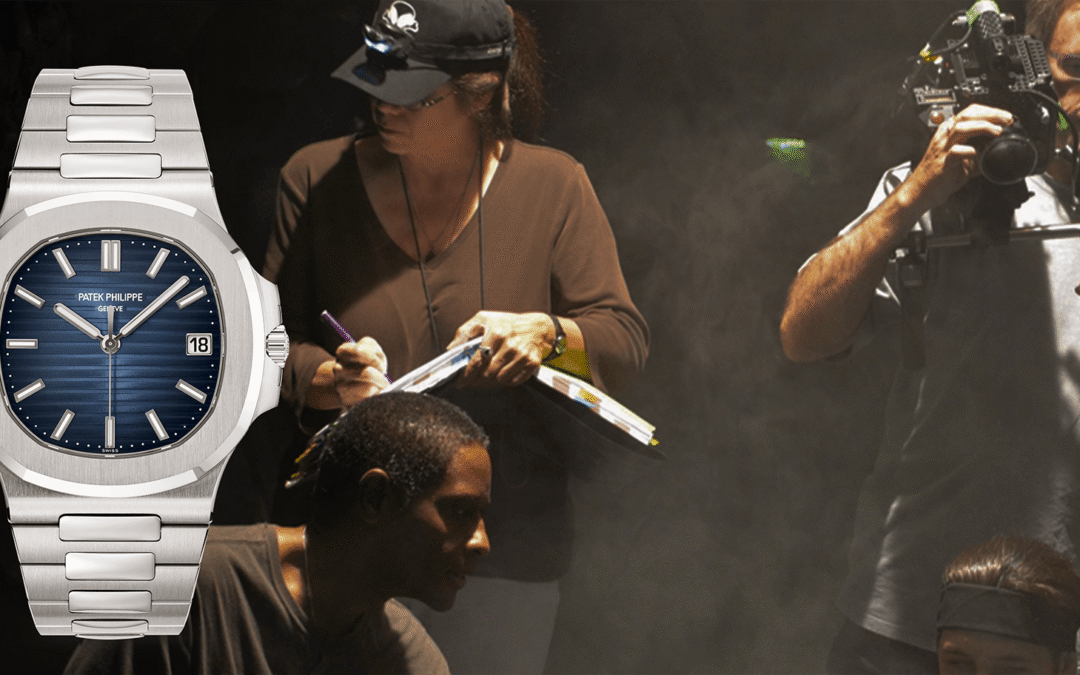
The Nautilus was designed by Gerald Genta in 1976. It took an integrated bracelet originally built for sport contexts and made it acceptable in formal ones. That tension, between serious and accessible, is exactly what the Timekeeper needs. The 5711 was discontinued in 2021 and its secondary market price in Dubai currently sits between AED 250,000 and AED 320,000 depending on condition and papers. The 5811, the white gold successor, trades slightly differently but carries the same architectural logic.
The Aquanaut 5167A is the case for buyers who find the Nautilus too considered. Same design DNA, steel case, rubber strap, slightly sportier reading. In Dubai’s pre-owned market it trades at around AED 100,000 to AED 130,000 for recent references with full documentation, making it one of the stronger value propositions in the Patek range for a first serious purchase.
Who this is: Someone who thinks in decades, not quarters. They watch the WatchCharts index the way others watch equity markets. They are not buying for enjoyment alone. They are buying for position. They want a piece that holds value through market cycles, not just one that looks good at the moment of purchase.
The Royal Oak launched in 1972 at a price five times higher than any other steel watch available. The Swiss industry thought it was a commercial disaster waiting to happen. It was not. In Dubai’s current pre-owned market, the Royal Oak 15500ST in steel trades at AED 200,000 to AED 250,000 for clean examples with box and papers. The Royal Oak Offshore in ceramic, as we stock at WatchX, recently moved through our showroom at AED 265,000, down from AED 299,000, which reflects a market correction from the 2022 peak rather than a structural decline in the reference.
The Vacheron Constantin Overseas is the choice for buyers who want the same integrated bracelet architecture as the Royal Oak but with a different story behind it. The Overseas Perpetual Calendar, worn by Robert Pattinson at various recent press events, carries a retail price above AED 500,000 and trades strongly in the secondary market. It suits the Strategist who prefers to move in a slightly less crowded space than Royal Oak buyers.
Who this is: Someone who lives between cities. Dubai to London to Singapore, with a layover somewhere in between. They need a watch that works as hard as they do and does not require explanation in any timezone. GMT function is not optional for this person. It is the whole point.
The GMT-Master II was built in 1954 in partnership with Pan American World Airways, designed specifically for long-haul pilots who needed to track two time zones simultaneously. That original brief has not changed. What has changed is the secondary market around it.
In Dubai’s pre-owned market in August 2026, the GMT-Master II Zombie, the two-tone steel and yellow gold reference with a black and gold ceramic bezel, is available through WatchX at AED 77,000, reduced from AED 84,000. The Pepsi in full Oystersteel trades between AED 85,000 and AED 95,000 for recent references. The Batman, preferred by buyers who want a more understated reading of the same complication, sits in a similar range.
Dubai’s position as a global aviation hub makes GMT references especially logical here. The UAE’s UHNWI population grew by 6,700 individuals in 2024 according to Henley and Partners, many of them multi-city operators for whom the Voyager archetype is simply a description of a Tuesday.
The full Rolex collection, including current GMT references, is available at WatchX Rolex.
The Quiet Collector
Who this is: Someone who knows exactly what they are wearing and does not need anyone else to notice. They have likely already owned louder pieces and moved past them. They are drawn to craft and proportion over recognition value. In 2026, this archetype is growing. The market for smaller case sizes and understated references has strengthened notably over the past 18 months.
The reference:Cartier Santos or Tank Louis, or the smaller case Patek Philippe Nautilus 7118.
The Cartier Tank has been in continuous production since 1917. Louis Cartier based the case shape on a top-down view of the Renault FT tank, which was then changing the course of the First World War. It is one of the few watches that has been worn by Andy Warhol, Princess Diana, and Jackie Kennedy without anyone claiming it did not fit. The Tank Louis Cartier in yellow gold, Ref WGTA0343, currently retails new at around $13,900 USD. Pre-owned examples in excellent condition with papers represent genuine value against the retail price.
The Patek Nautilus 7118, the 35.2mm ladies’ variant, has seen a pronounced increase in demand among collectors who want the Nautilus story in a smaller form. It suits wrists and wardrobes that the 5711 overwhelms, and it trades with strong liquidity in Dubai’s secondary market.
The typical WatchX buyer in JLT is not buying their first watch. They usually own two or three pieces already and are thinking about the next purchase with more deliberation than the previous ones. They live a cross-border life, they understand capital allocation, and they are making a purchase that sits at the intersection of personal taste and financial logic.
Dubai’s free zone economy and its position as a hub between East and West mean the Voyager and the Strategist archetypes are particularly well represented here. The DIFC, Business Bay, and JLT corridors contain a high concentration of buyers who are genuinely weighing a Patek Aquanaut against a Royal Oak on investment merit as much as personal preference.
The Quiet Collector has become more visible in Dubai over the past two years. The shift towards smaller, more considered pieces that Forbes and WatchCharts both documented in early 2026 reflects a maturation in buying behavior, particularly among younger HNWIs who grew up watching the 2022 hype cycle and came away with a different set of priorities.
How to Choose Based on Archetype
The most common mistake a buyer makes is choosing based on what they think they should want rather than what their actual life requires. A Voyager who buys a Tank because it looks beautiful will reach for it less than they should. A Strategist who buys a Submariner because everyone recommends it will wonder why it does not satisfy them the way they expected.
The framework is not complicated. Think about the three or four occasions you wear a watch most often. Think about which of the archetypes above describes the version of yourself that shows up on those occasions. Start there.
For help matching a specific reference to how you actually live and work, WatchX offers a sourcing and advisory service through the Watch Concierge in Dubai.
Frequently asked questions
Which watch suits someone who travels constantly between time zones?
Which watch suits someone who travels constantly between time zones? The Rolex GMT-Master II is the clearest answer. It was built for this exact purpose in 1954 and nothing in the current market covers the same function at the same quality level at a comparable price point. In Dubai’s pre-owned market, clean GMT references with papers are available between AED 77,000 and AED 95,000 depending on the reference and year.
Which watch suits a buyer who treats watches as long-term assets?
The Audemars Piguet Royal Oak 15500ST and the Patek Philippe Nautilus 5711 have both demonstrated strong value retention through the 2022 correction and into 2026. The Vacheron Constantin Overseas is the less crowded alternative for buyers who want the same architecture with a different provenance story.
Which watch suits someone who prefers quiet luxury over hype?
The Cartier Tank Louis in yellow gold and the Patek Philippe Nautilus 7118 both suit buyers who have moved past recognition value as a primary criterion. Both trade with strong liquidity in Dubai’s secondary market and have long histories that do not depend on any single cultural moment.
Does personality matter when choosing a pre-owned luxury watch?
Yes, in a practical sense. A watch you do not naturally reach for is one you will eventually sell at a suboptimal moment. Matching the reference to how you actually live reduces that risk and tends to produce better long-term outcomes both personally and financially.
How should I think about my first serious watch in terms of archetype?
Start with the archetype that describes your daily life most accurately, not your aspirational life. A first serious purchase should be something you wear often. Frequency of wear is one of the strongest predictors of satisfaction with a pre-owned watch purchase.
What is the difference between the Patek Nautilus 5711 and the Aquanaut 5167A for a first serious purchase?
The 5711 is discontinued, which creates both scarcity value and a higher entry price. The Aquanaut 5167A is in production, trades at a lower price point, and carries the same architectural DNA. For a first purchase where budget is a consideration, the Aquanaut is the stronger practical argument. For a buyer who has decided the Nautilus is the destination regardless, the 5711 is worth the premium.
Where can I find certified pre-owned Patek Philippe, Rolex, Audemars Piguet, Cartier, and Vacheron Constantin in Dubai?
WatchX is based in JLT, Cluster C, Dubai. The full collection is available at watchxglobal.com/shop and the Watch Concierge service handles sourcing requests for specific references not currently in stock.
Not every pre-owned Rolex behaves the same way in Dubai’s secondary market. Steel sports models trade above retail and sell in days. Certain Datejust and Oyster Perpetual references are accessible within a month at prices that represent strong value for the first-time buyer. Some references are bought to wear daily, others because they have the strongest track record for holding value, and a small number are bought for both reasons at once. This guide breaks the current Dubai pre-owned Rolex market into honest budget tiers using real AED prices from mid-2026, with specific reference recommendations for each one.
AED 20,000 to AED 35,000: where serious Rolex starts
This range is where a buyer steps out of fashion watches and into pieces with genuine secondary market credibility. The Rolex name, the Superlative Chronometer certification and the in-house movement are present at every price point. The differences are case size, complication and the collector weight of the specific reference.
Rolex Oyster Perpetual 41 (ref 124300)
The Oyster Perpetual is Rolex’s purest expression of the Oyster case. No date, no complication, clean dial. The 41mm 124300 in the coloured dial variants (coral, turquoise, yellow) has developed genuine collector interest since its 2020 introduction and trades pre-owned in Dubai from AED 22,000 to AED 32,000. For a first Rolex that will hold its value without requiring premium allocation, the OP is the honest recommendation at this price point.
Rolex Datejust 36 (older references)
Older Datejust 36 references in steel, particularly the 116200 and 16220, trade from AED 18,000 to AED 28,000 pre-owned in Dubai. These are not growth assets in the same way as sports references, but they are genuine Rolex pieces at accessible prices with strong brand recognition and reliale movement quality. A buyer at this tier who prioritizes daily wear over investment logic will find the older Datejust to be the most versatile option.
AED 35,000 to AED 55,000: the core Rolex zone
This is where the most actively traded references in Dubai’s pre-owned market sit. Buyers at this tier are most often making their first serious Rolex purchase after one to two years of accumulating Dubai savings. The Submariner No-Date is the cleanest recommendation in this range.
Rolex Submariner No-Date 124060
The no-date Submariner is the collector’s configuration. No date window at 3 o’clock, cleaner dial symmetry, slightly lower price than the date version. Pre-owned pricing in Dubai sits between AED 36,000 and AED 46,000 for clean examples with papers. The 124060 runs the current Caliber 3230 with a 70-hour power reserve and 100 meters of water resistance. It is the reference that watch-literate buyers in Dubai point to when asked what they would buy at this budget with both daily use and resale in mind.
Rolex Datejust 41 (ref 126331 and 126300)
The Datejust 41 in steel with a Jubilee bracelet is Dubai’s most versatile pre-owned Rolex. It moves from business settings to weekend wear without friction and trades pre-owned from AED 28,000 to AED 42,000 depending on dial, condition, and papers. For a buyer who needs a single watch that works across a broad range of contexts, the Datejust 41 is the practical recommendation. It will not trade at a premium over retail, but it will hold its value reliably and find a buyer quickly when the time comes to sell.
AED 55,000 to AED 85,000: the sports watch zone
This tier contains the references that Dubai pre-owned buyers search for most actively. Supply is constrained at authorized dealers for all of them. Immediate availability is the secondary market’s primary advantage here.
Rolex Submariner Date 126610LN
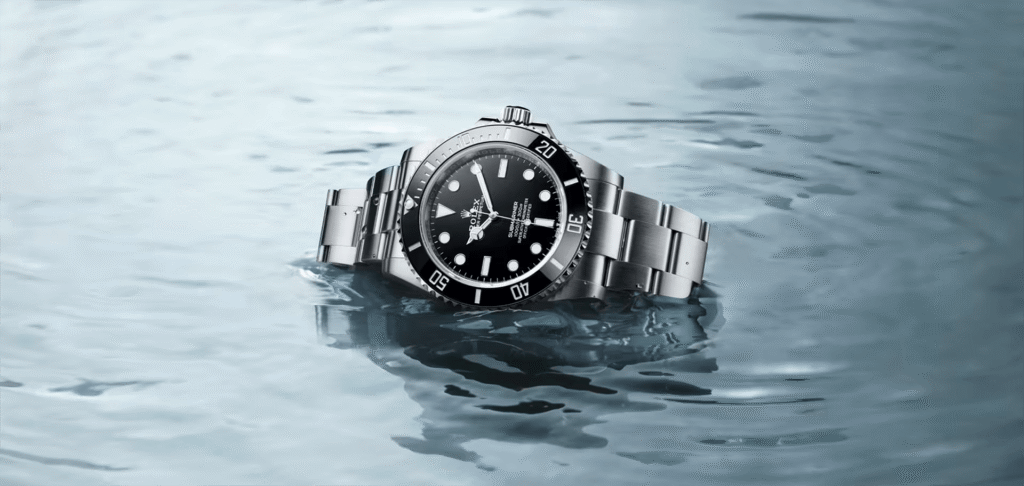
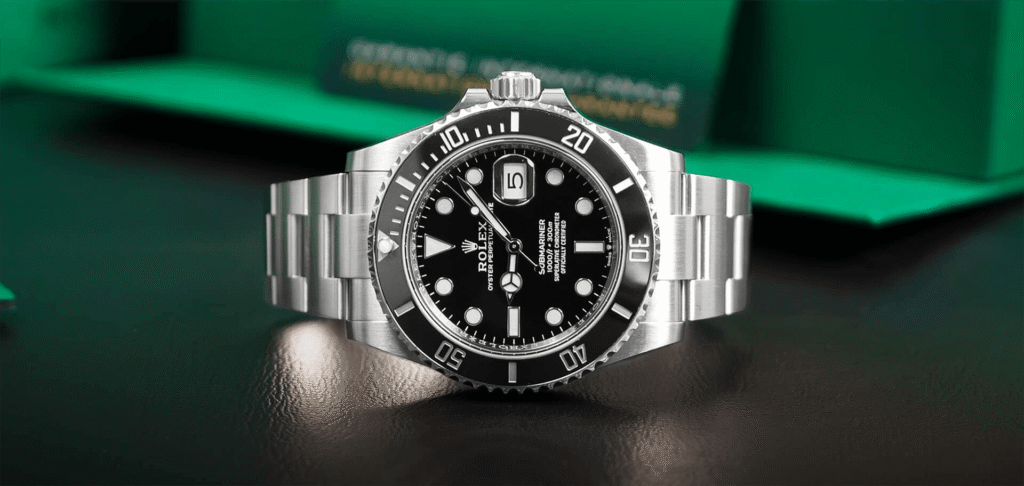
The current-generation Submariner Date in stainless steel with a black ceramic bezel is the most consistently liquid pre-owned watch in Dubai. Median sell time for a full-set example on established platforms is under one week. Pre-owned pricing ranges from AED 46,000 to AED 58,500 depending on year, condition, and papers. Full-set unworn 2024 and 2025 examples have been listed in Dubai at AED 54,500 to AED 58,500. The Submariner Date’s cross-generational and cross-cultural appeal makes it the most reliable first sports Rolex in any market.
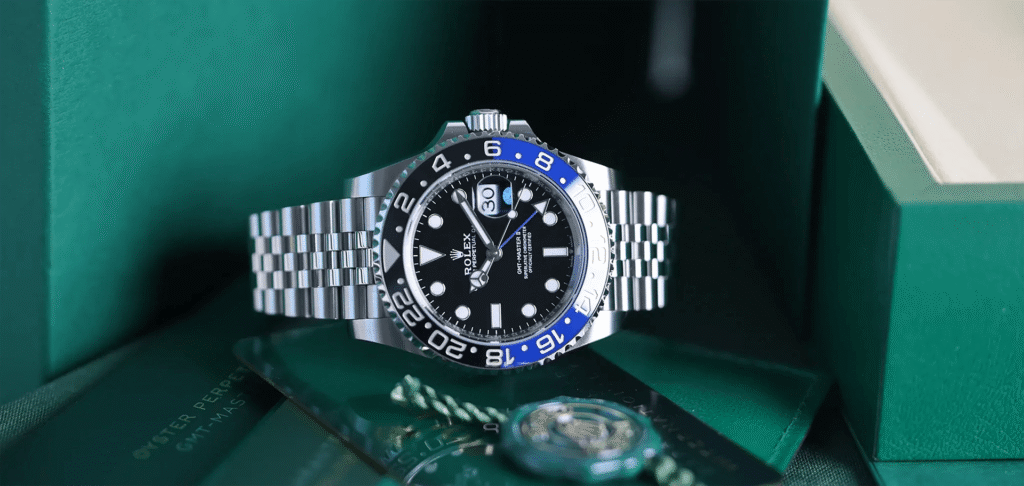
Rolex GMT-Master II Batman 126710BLNR
The Batman, with its blue and black ceramic bezel on a Jubilee bracelet, was the first GMT-Master II to receive the ceramic bezel update when it launched in 2013. Pre-owned pricing in Dubai sits between AED 63,000 and AED 68,000, approximately 31% above current retail. It is the GMT recommended for buyers who want strong name recognition, practical travel watch function and a second time zone without the Pepsi’s higher premium.
Rolex GMT-Master II Pepsi 126710BLRO
The Pepsi is the most searched GMT reference in the UAE market. Red and blue ceramic bezel, Jubilee bracelet, the visual connection to the original 1954 Pan Am pilot’s watch. Pre-owned pricing ranges from AED 78,000 to AED 95,000, placing it at the top of this tier. It trades at approximately 44% above retail because authorized allocation is genuinely difficult and demand from collectors and first-time buyers overlaps in a way that keeps the floor supported.
Rolex Submariner Starbucks 126610LV
The green ceramic bezel Submariner trades from AED 61,500 to AED 65,000 pre-owned in Dubai. The Starbucks nickname comes from the green and black colorway. It has strong visual recognition among buyers who know the reference and sits comfortably between the standard LN and the GMT at this price tier. For a buyer who wants the Submariner format with something visually distinct from the black bezel standard, the 126610LV is the right recommendation.
AED 90,000 and above: the Daytona tier
The Daytona stainless steel 126500LN begins at AED 90,000 pre-owned in Dubai and represents the highest-premium reference in Rolex’s steel lineup. It trades above retail because of the chronograph function, the historical significance of the waitlist that surrounded the reference for decades, and the emotional weight that the Daytona carries for serious collectors. A buyer at this price point is making a different kind of decision than at lower tiers: this is a piece acquired because of what it is, not only because of what it does.
The yellow gold Daytona 126508 and the Everose Daytona 126515LN are available in Dubai’s pre-owned market from AED 130,000 upward, with the two-tone Root Beer 126711CHNR offering an entry into gold-case Daytonas from approximately AED 145,000.
Steel sports models retain value most reliably because authorized supply remains structurally constrained. The Submariner Date, GMT-Master II and Daytona in stainless steel all trade above their retail equivalents in Dubai. This has been consistent since the post-2022 correction and shows no sign of reversing while allocation constraints at authorized dealers persist.
Coloured dial Oyster Perpetual references have held value better than many expected since 2020. The turquoise and coral dials in particular developed collector support and trade above their retail prices. They are not as liquid as sports models, but they have a stable secondary market in Dubai.
Dress references (Datejust, Day-Date) hold value reliably but do not trade at premiums. A buyer who wants to own a Rolex at the lowest total cost of ownership over a five-year period may find the Datejust 41 a more efficient choice than a sports reference trading at a 30% premium over retail. The investment case for sports references is about absolute liquidity and speed of sale, not necessarily about total return.
Five things to check before buying any pre-owned Rolex in Dubai
One: read the reference number before you touch the watch
The reference number is on the case between the lugs at 6 o’clock. It encodes the case material, dial configuration, bracelet type, and production generation. The Submariner 126610LN and the 116610LN look nearly identical but differ in movement caliber, power reserve and bracelet design. Knowing the reference number for the watch you are targeting means you cannot be misled about what you are holding.
Two: confirm box and papers status in writing before any transfer
Original box and papers on a Rolex can add 20 to 40% to resale speed and meaningfully to resale price on sports models. The original Rolex warranty card establishes the production period and authenticates the piece in any subsequent sale. Request documentation status confirmed in writing, not verbally.
Three: check the case and bracelet condition carefully
Over-polished cases lose the sharp lug lines and brushed surfaces that define the sports Rolex aesthetic. Stretched bracelet links on Submariner and GMT add replacement cost at resale. These are not cosmetic preferences. They are pricing factors that experienced buyers apply immediately on viewing.
Four: never buy from an individual without dealer verification
Counterfeit Rolex watches circulate at the individual seller level, not primarily at licensed dealers. A buyer who saves on dealer margin by purchasing from an individual is taking on authenticity risk that is very difficult to assess without professional equipment and reference knowledge.
Five: understand the Dubai VAT refund for non-residents
UAE VAT is 5% on luxury watch purchases. Buyers leaving the UAE are eligible for a VAT refund at the airport through the Planet Tax Free system. On a AED 55,000 Submariner, that is approximately AED 2,750 recoverable at departure. Keep the original receipt and original packaging for the refund process.
Which pre-owned Rolex models are best to buy in Dubai in 2026?
For buyers focused on liquidity and value retention, the Submariner Date 126610LN, the GMT-Master II Pepsi 126710BLRO and the Daytona 126500LN are the strongest references in the current Dubai market. For first-time buyers on a lower budget, the Oyster Perpetual 41 and the Submariner No-Date 124060 are the most recommended starting points. Each combines genuine Rolex quality with reliable secondary market support.
What is a good first Rolex for under AED 50,000 in the UAE?
The Rolex Submariner No-Date 124060 is available pre-owned in Dubai from approximately AED 36,000 to AED 46,000 and is the most respected recommendation at this price point for a buyer who wants a serious sports Rolex. The Oyster Perpetual 41 in a coloured dial is available from AED 22,000 to AED 32,000 and is the more accessible starting point for buyers at the lower end of the range.
Does a Submariner hold value better than a Datejust?
Yes, in the Dubai secondary market. The Submariner trades above retail because of structural supply constraints at authorized dealers. The Datejust holds value well but trades at or near retail equivalents because supply in the secondary market is plentiful and collector urgency is lower. For a buyer who may sell within three to five years, the Submariner has the faster secondary market exit and the stronger premium preservation.
How much should I expect to pay for a GMT-Master II Pepsi in Dubai?
The GMT-Master II Pepsi 126710BLRO trades between AED 78,000 and AED 95,000 pre-owned in Dubai in mid-2026, representing approximately 44% above current Rolex retail. Full-set examples at the lower end of that range are the best value entry point. Prices at the higher end typically reflect unworn recent production examples or particularly clean documentation.
Should I worry about box and papers when buying a pre-owned Rolex?
Yes. Original documentation on a Rolex adds to both resale price and resale speed. On a sports model, a full-set example with original box and warranty card sells faster and commands a premium over the same reference without documentation. The gap varies by reference and condition but consistently favors the full-set buyer on exit. Always confirm documentation status in writing before purchasing.
Is it safe to buy a pre-owned Rolex from an individual in Dubai?
The risk is meaningfully higher than buying from a licensed dealer. Individual sellers carry no accountability under UAE trade law and have no incentive to disclose condition or authenticity issues. Counterfeit Rolex watches are present at the individual seller level. A dealer who operates under a UAE trade license risks losing it by selling fakes. The cost saving from skipping a dealer is rarely justified once authenticity risk is accounted for.
How do Rolex prices compare between Dubai and other major markets?
Dubai is generally competitive with London, Hong Kong and Geneva for pre-owned Rolex. The UAE’s 5% VAT is significantly lower than European VAT rates, and non-resident buyers can recover it at departure. The absence of additional luxury or import taxes makes Dubai one of the more attractive markets globally for pre-owned sports Rolex acquisition. Prices track the global secondary market closely because the buyer and seller base is international.